Gary Saretzky Photo Books
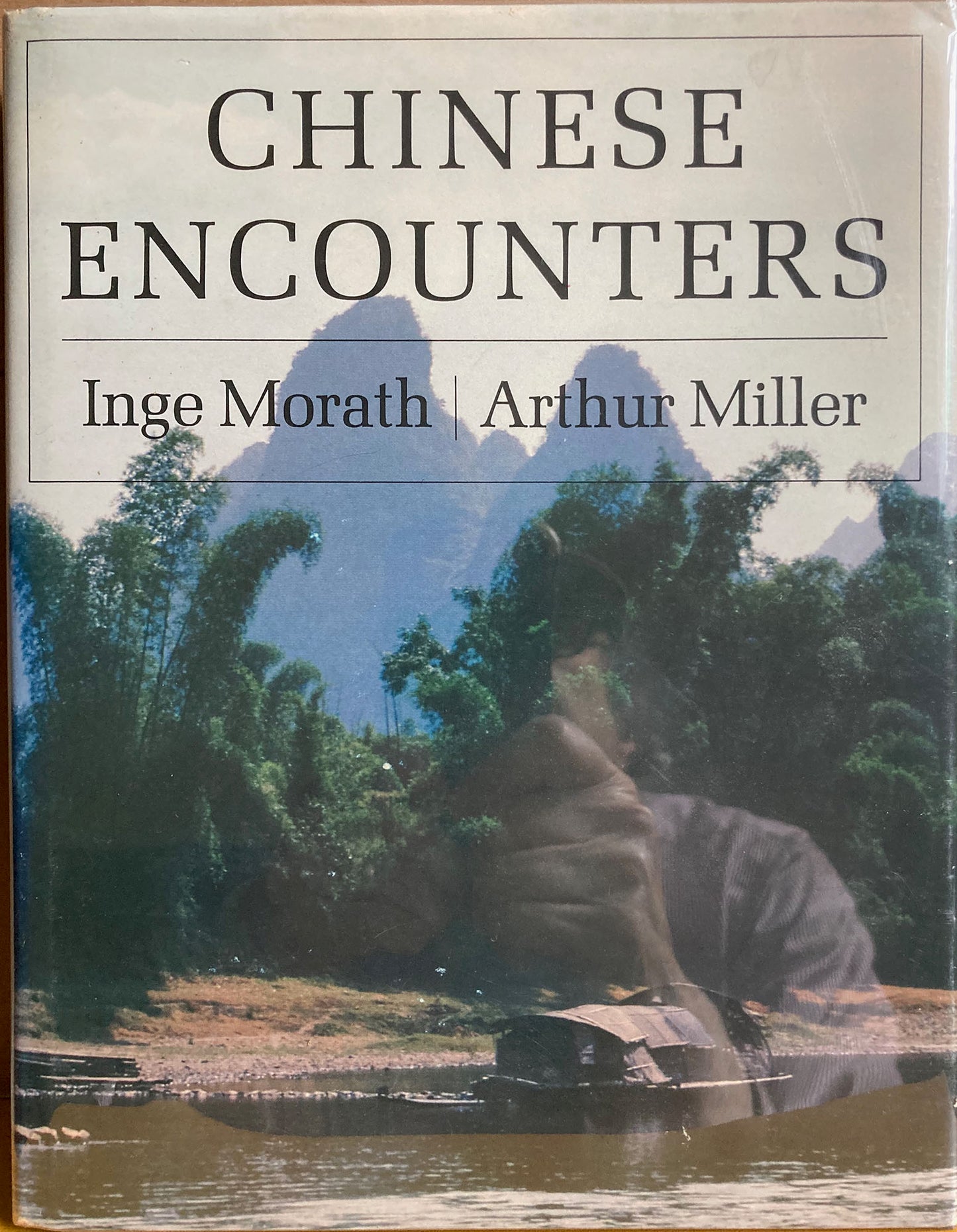
Morath, Inge. Chinese Encounters by Inge Morath and Arthur Miller.
Morath, Inge. Chinese Encounters by Inge Morath and Arthur Miller.
Impossible de charger la disponibilité du service de retrait
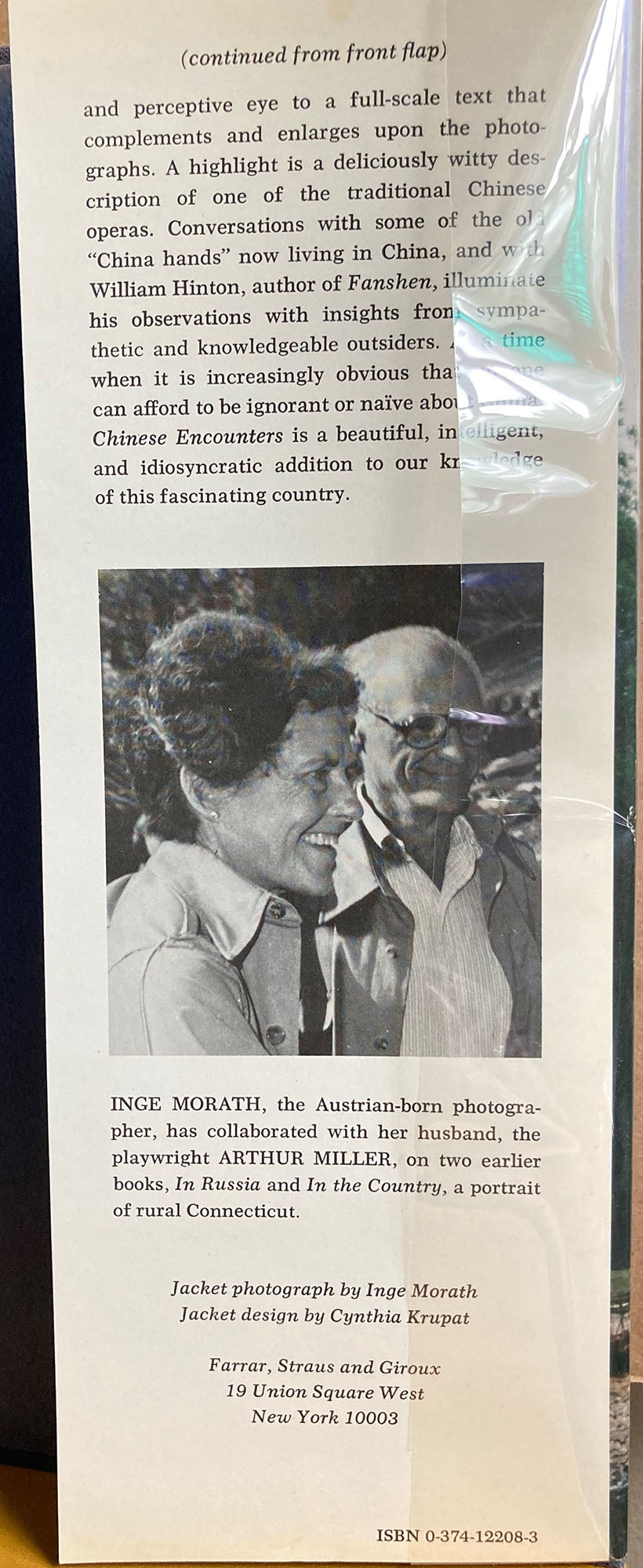
Farrar, Straus, Giroux, 1979. First edition, first printing. Hardcover in blue cloth, fine with very good protected dust jacket chipped at spine tips. 255 pages with numerous black-and-white photos by Inge Morath (1923-2002). Text by her husband Arthur Miller. This is one of a number of books they published together. After working as an editor and writer for Magnum after WWII, Morath began photographing in 1951 and joined as a member of Magnum in 1955, becoming among the best known women photographers of her era. Summary:
Chinese Encounters (1979) is a unique collaborative travelogue created by the legendary Magnum photographer Inge Morath and her husband, the acclaimed playwright Arthur Miller. It documents their journey through China in 1978, a pivotal moment just as the country was emerging from the isolation and trauma of the Cultural Revolution.
Key Themes and Insights
-
The Thaw of the "Hundred Flowers": Miller’s text focuses heavily on the intellectual and artistic climate. He interviews writers, actors, and directors who had been "sent to the countryside" or imprisoned, recording their tentative hopes and lingering fears as they began to return to public life.
-
The Human Face of China: Morath’s photography avoids the stiff, propagandistic imagery common at the time. Instead, she captures candid, intimate moments—children in schoolyards, laborers on the street, and the quiet dignity of ordinary citizens reclaiming their individuality.
-
A Cultural Bridge: The book serves as a Western intellectual’s attempt to understand the "New China." Miller reflects on the parallels and vast differences between American individualism and Chinese collectivism, often with a mix of skepticism and deep empathy.
-
Visual Narrative: Morath’s black-and-white and color plates provide a stark, beautiful contrast to Miller's analytical prose, offering a sensory record of a society in the middle of a massive, uncertain transition.
Significance
Chinese Encounters is highly regarded as one of the first nuanced, "unfiltered" Western accounts of post-Mao China. It is valued both as a historical document of the "Beijing Spring" and as a testament to the creative partnership between one of the 20th century’s greatest photographers and one of its most piercing dramatists.
Inge Morath (1923–2002) was an Austrian-born photojournalist acclaimed for her intimate portraiture, worldly travel essays, and pioneering role as one of the first female members of the prestigious Magnum Photos agency. Originally working as a writer and editor in post-WWII Europe, Morath joined Magnum in 1949 as an editor before studying camera work alongside Simon Guttmann and Henri Cartier-Bresson, officially becoming a full Magnum photographer in 1955. Fluent in several languages, she traveled extensively across Europe, the Middle East, North Africa, the Soviet Union, and China, creating poignant, humanistic photo-essays that revealed deep empathy for diverse cultural landscapes. Her career encompasses famous portraits of cultural figures such as Saul Steinberg, Boris Pasternak, and Marilyn Monroe, as well as landmark photographic books produced alongside her husband, playwright Arthur Miller. Renowned for her intellectual rigor and keen eye for intimate human moments, her legacy lives on through the Inge Morath Award, established by Magnum Photos to support emerging female photographers.