Gary Saretzky Photo Books
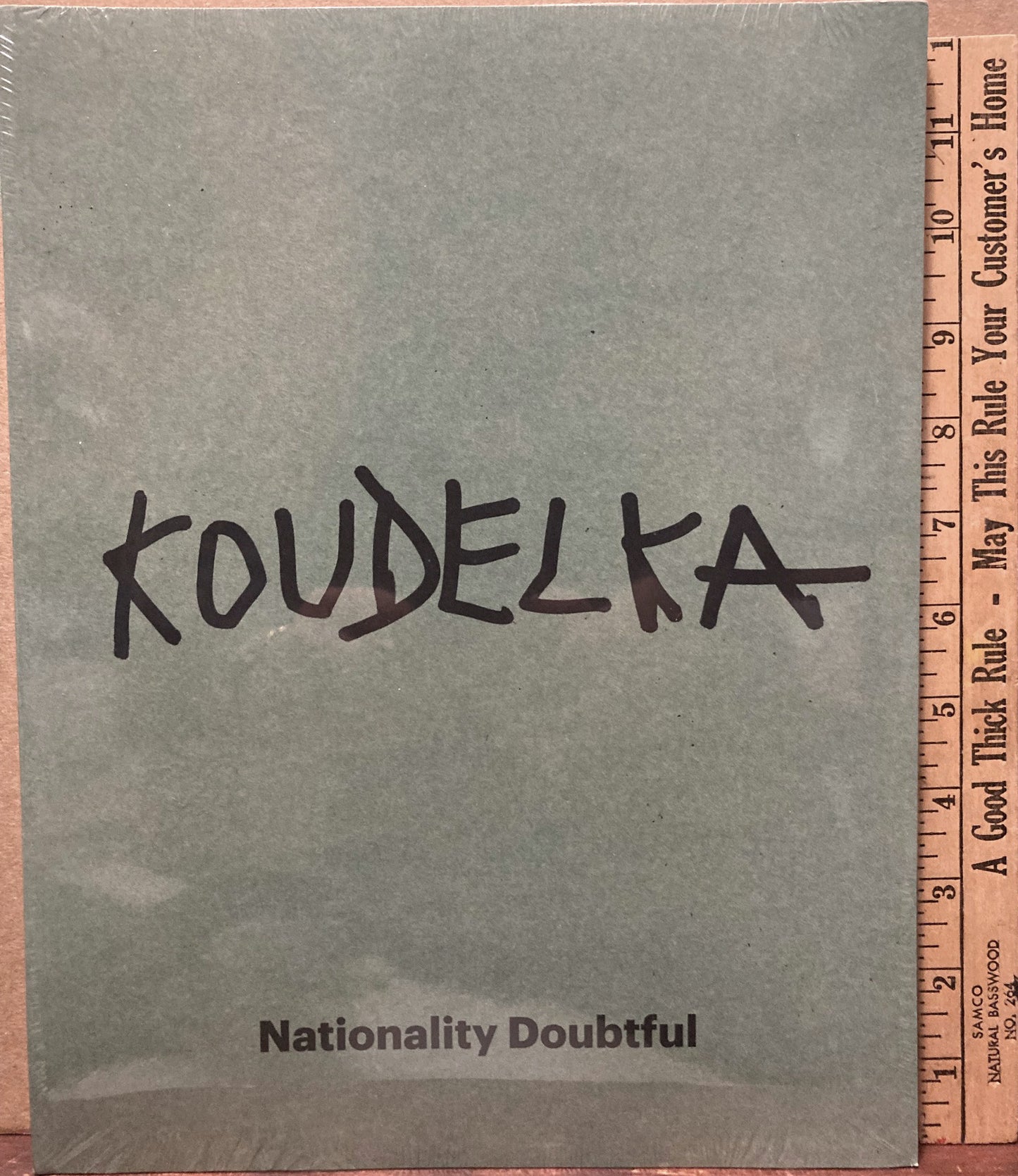
Koudelka. Nationality Doubtful. Photographs by Josef Koudelka.
Koudelka. Nationality Doubtful. Photographs by Josef Koudelka.
Impossible de charger la disponibilité du service de retrait
Art Institute of Chicago, 2014. First edition. Wraps, as issued. 225 pages. Exhibition catalog edited and with an essay by Matthew S. Witkovsky. Additional essays by Stuart Alexander, Amanda Maddox, and Gilles A. Tiberghien. An outstanding retrospective of Koudelka's extensive body of photographs with 200 mostly black and white images from the series Gypsies, Exiles, Russian invasion of Prague, Czechoslovakia, and landscapes, the last from the series Archaeology, Wall, Chaos, panoramas, reproductions of the pages from Koudelka's book, Black Triangle, and others, with both well known and previously unpublished work. New in original shrink wrap. Very uncommon in this condition.
Josef Koudelka (born 1938) is a legendary Czech-French documentary photographer and long-time member of Magnum Photos, internationally celebrated for his raw, starkly poetic depictions of human resilience, displacement, and industrial landscape. Born in Boskovice, Moravia, Koudelka initially trained and worked as an aeronautical engineer in Prague before devoting himself fully to photography in 1967. He first drew wide acclaim for his immersive, empathetic studies of Romani communities across Eastern Europe, which culminated in his seminal monograph Gypsies (1975). In August 1968, Koudelka secretly photographed the Warsaw Pact invasion of Prague; smuggled out of Czechoslovakia and published anonymously under the moniker "P.P." (Prague Photographer), his visceral images became defining symbols of political resistance and earned him the Robert Capa Gold Medal. Seeking political asylum in England in 1970, he embarked on a nomadic life across Europe, producing Exiles (1988), a masterpiece exploring themes of alienation, rootlessness, and existential longing. In later decades, Koudelka turned to panoramic view cameras to document heavily scarred, industrial, and historic landscapes—most notably in Black Triangle (1994) and Wall (2013). Honored with the Hasselblad Foundation International Award and the Grand Prix Henri Cartier-Bresson, Koudelka remains one of modern photography’s most revered visual poets of exile and the human condition.
Nationality Doubtful (2014) is a comprehensive retrospective of the life and work of Josef Koudelka, one of the most influential and fiercely independent photographers of the 20th century. Published in conjunction with a major exhibition at the Art Institute of Chicago and the Getty Museum, the book’s title refers to the legal status Koudelka held for decades as a stateless person after fleeing Czechoslovakia.
The Concept of "Nationality Doubtful"
The title reflects Koudelka’s lifelong experience as an outsider. After his 1970 asylum in the UK, his travel documents were often marked "Nationality Doubtful." This state of permanent exile deeply informed his visual perspective—that of a nomad observing a world of borders, displacement, and the remnants of history.
Major Thematic Cycles
The book is organized into the definitive chapters of Koudelka’s career, tracing his evolution from a theater photographer to a grand master of the panoramic landscape:
1. Early Theater and Roma (Gypsies)
Before his exile, Koudelka worked in Prague, developing a graphic, high-contrast style. This culminated in his decade-long study of Roma communities across Europe. These images are noted for their raw intimacy and their portrayal of a culture that existed outside the "official" structures of society.
2. The 1968 Invasion of Prague
The book includes his legendary, anonymous documentation of the Soviet-led invasion of Prague. These photos, smuggled out of the country and published under the initials "P.P." (Prague Photographer), became global symbols of resistance and the crushing of the "Prague Spring."
3. Exiles
Following his departure from Czechoslovakia, Koudelka wandered Europe with the Magnum Photos collective. Exilescaptures the alienation of the modern world—abandoned objects, lonely animals, and people existing on the margins of society. The compositions are often surreal, emphasizing a sense of existential homelessness.
4. Chaos and Panoramas
The latter part of the book focuses on Koudelka’s shift to the panoramic camera. These wide, haunting images document:
-
The Black Triangle: Industrial devastation in Eastern Europe.
-
Archaeological Sites: Ruins in the Mediterranean that reflect the rise and fall of civilizations.
-
The Wall: The separation barrier in the West Bank, viewed through a lens of monumental, stark geometry.
Visual Style and Philosophy
-
The Decisive Graphic: Koudelka’s work is characterized by a "hard" aesthetic—high contrast, deep blacks, and a rigorous attention to the geometry of the frame.
-
Aversion to Sentiment: Despite his subject matter, Koudelka avoids pity. He presents a world that is harsh and indifferent, yet possesses a strange, rugged beauty.
-
Persistence of Vision: The book highlights Koudelka’s obsessive nature; he often spent decades on a single project, returning to the same locations or themes until he felt he had captured their essence.
Summary Takeaway
Nationality Doubtful is more than a photography book; it is a biography of a vision. It charts the journey of a man who surrendered his country and his home to maintain his artistic freedom. It serves as a definitive document of how Koudelka’s personal displacement allowed him to become a unique witness to the displacements, ruins, and resilience of the human spirit.