Gary Saretzky Photo Books
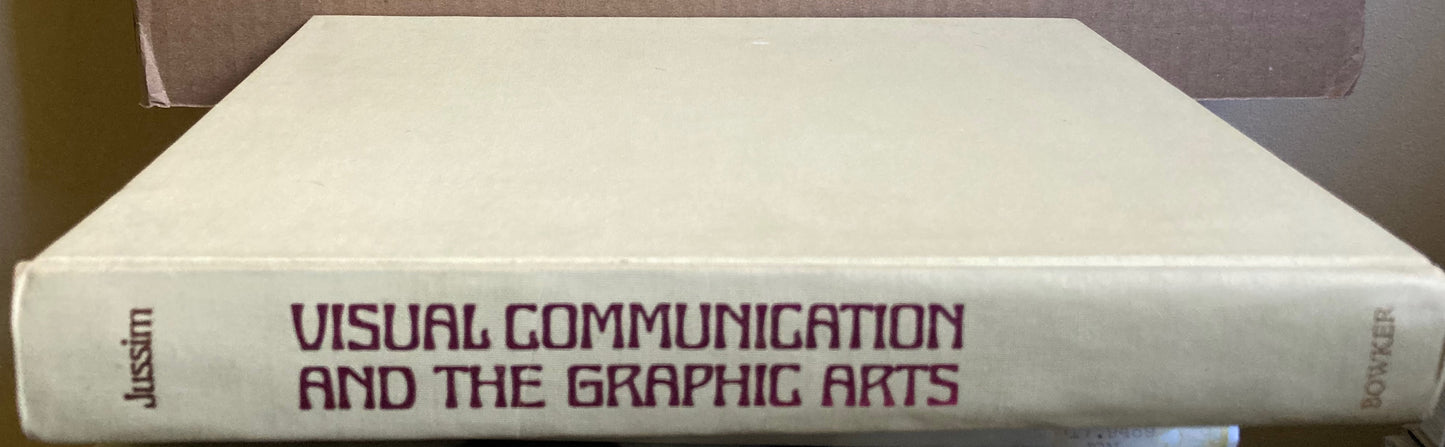
Jussim, Estelle. Visual Communication and the Graphic Arts: Photographic Technologies in the Nineteenth Century by Estelle Jussim.
Jussim, Estelle. Visual Communication and the Graphic Arts: Photographic Technologies in the Nineteenth Century by Estelle Jussim.
Impossible de charger la disponibilité du service de retrait
Bowker, 1974. Presumed first edition. Almost like new in hardcover, cloth, without dust jacket. 364 pages. Thorough analysis, still considered the standard work. Topics covered: Graphic Arts; Impact of Photography on Graphic Arts; Howard Pyle; William Hamilton Gibson; Frederic Remington; Art History; Photographic Technology; Heliotype; Engraving; Photogravure; Photomechanical Processes; Half-tone; Lithography, et al. Summary:
Visual Communication and the Graphic Arts, published in 1974, is a seminal work by Estelle Jussim that revolutionized how we understand the relationship between photography and traditional print media. It challenges the "linear" history of art by examining how the shift from hand-engraved illustrations to photographic processes fundamentally altered human perception.
Central Thesis
Jussim argues that the transition to photographic technologies was not merely a technical upgrade, but a communicative revolution. She focuses on the shift from:
-
The Syntax of the Tool: Where an artist’s hand-coded lines (wood engraving, etching) dictated how information was seen.
-
The Syntax of the Lens: Where the "process-reproduction" of photography introduced a new, seemingly objective visual language.
Key Themes
-
The Death of the "Hand": The book details how photomechanical processes (like halftone and photogravure) replaced the interpretive work of the engraver, leading to a new standard of "visual truth."
-
Impact on Illustration: Jussim examines how major artists—specifically Howard Pyle, Frederic Remington, and William Hamilton Gibson—adapted their styles as their work began to be reproduced via camera rather than by hand-carved blocks.
-
Information Theory: Drawing on the ideas of William Ivins, Jussim applies communication theory to art history, treating the printed image as a "message" influenced by its "medium."
Significance
This book is considered a cornerstone of visual literacy. Jussim demonstrates that the "photographic revolution" did more than just create a new art form; it permanently changed the "visual syntax" of the modern world, dictating how we receive, trust, and interpret information.
Estelle Jussim (1928–2004) was an art historian, critic, educator, and prolific author of books and essays on visual communication and photography. She had teaching positions at Hampshire College and then Simmons College, where she taught history of photography, history of rare books, and graphic arts and communications. In addition to this book, her other major works included Slave to Beauty, the Eccentric Life and Controversial Career of F. Holland Day and Landscape as Photograph, co-authored by Elizabeth Lindquist-Cock. She contributed texts to monographs on photographers such as Carl Chiarenza, Barbara Crane, Barbara Kasten, Jerome Liebling, and John Pfahl, and wrote periodical articles for Aperture, Close-Up and other journals.