Gary Saretzky Photo Books
Imes, Birney. Partial to Home: Photographs by Birney Imes.
Imes, Birney. Partial to Home: Photographs by Birney Imes.
Impossible de charger la disponibilité du service de retrait
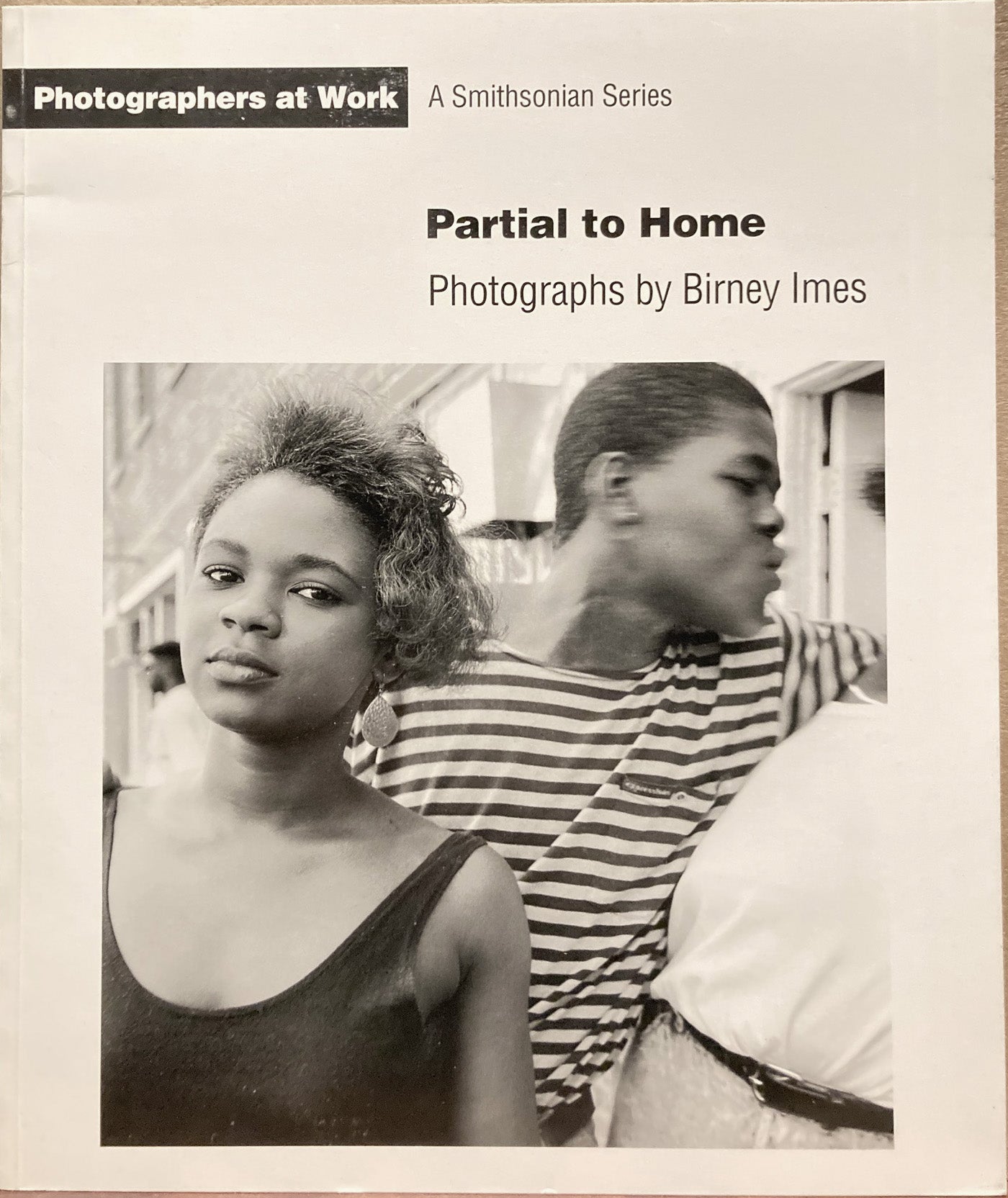
Photographers at Work. A Smithsonian Series. Smithsonian Institution Press, 1994. First edition. Illustrated wraps, like new. [Photographs of mostly African American people in Mississippi.] Summary:
Partial to Home (1994) is a soulful, intimate monograph by Birney Imes that serves as a sequel in spirit to his celebrated Juke Joint. While his previous work focused on the vibrant, neon-lit interiors of Mississippi social spots, this book turns its gaze toward the broader, everyday life of the Mississippi Delta, focusing on the intersections of family, race, and poverty with a deep sense of place.
The Essence: A "Native Son" Perspective
Unlike many documentary photographers who approach the American South as outsiders, Imes is a lifelong resident of Columbus, Mississippi. This "insider" status allows him to capture the Delta not as a spectacle, but as a home.
-
The Title: "Partial to Home" reflects both Imes’s affection for the region and the "partial" or fragmented nature of memory and change in a place rooted in tradition.
Key Themes and Imagery
1. The Domestic and the Mundane
The book is a collection of quiet moments found in kitchens, front porches, and backyard gatherings. Imes focuses on the details that define a life: a cluttered mantle, a hand-me-down dress, or the specific way light hits a screen door.
2. The Persistence of the Past
Imes documents a landscape where the past is physically present. The photographs often feature:
-
Aging Architecture: Weathered shotgun houses and crumbling stores that speak to the economic history of the South.
-
Intergenerational Portraits: Images that show the deep connection between elders and children, suggesting a cyclical continuity of life in the Delta.
3. Color as Narrative
Imes’s use of color is a hallmark of the book. He avoids the "pretty" or overly saturated color seen in commercial photography, instead using a palette that feels:
-
Naturalistic yet Poetic: He captures the dust-heavy atmosphere of a summer afternoon or the faded primary colors of local signage.
-
Atmospheric: The color work emphasizes the heat, the humidity, and the stillness of the rural South.
Visual Style: The "Gentle" Documentary
Imes’s style is notably non-confrontational. His subjects often look directly at the camera with a sense of trust and composure. There is an absence of the "poverty porn" that sometimes plagues documentary work of the rural South; instead, there is a profound sense of dignity and stoicism.
Summary Takeaway
Partial to Home is a lyrical, slow-paced exploration of Black and white life in the deep South. It is a book about the "extraordinary ordinary," arguing that the most profound truths about a culture are found not in its crises, but in its quietest, most private corners. It solidified Birney Imes's reputation as one of the most empathetic chroniclers of the American Southern experience.
Biographical Summary
Birney Imes (born 1951) is an American photographer celebrated for his intimate, evocative color and black-and-white visual chronicle of the Mississippi Delta and the American South. Born into a prominent newspaper family in Columbus, Mississippi, Imes earned a Bachelor of Arts in history from the University of Tennessee in 1973 before returning to his hometown to work as a photographer and reporter for the family-owned Commercial Dispatch. Beginning in the mid-1970s, he turned his medium-format camera toward the subcultures and rural landscapes of his home state, gaining national acclaim for his vibrant visual exploration of African American blues clubs and roadside juke joints. His work culminated in three landmark photographic monographs published by the University Press of Mississippi: Juke Joints(1990), Whispering Pines (1994)—a poignant study of an isolated, family-run rural bar—and Partial to Home (1994), an intimate black-and-white portrait of daily life in his hometown. A recipient of a National Endowment for the Arts grant, Imes’s work is held in major permanent collections, including the Museum of Modern Art in New York, the Art Institute of Chicago, and the San Francisco Museum of Modern Art, establishing him as one of the South's most empathetic and distinctive visual essayists.
