Gary Saretzky Photo Books
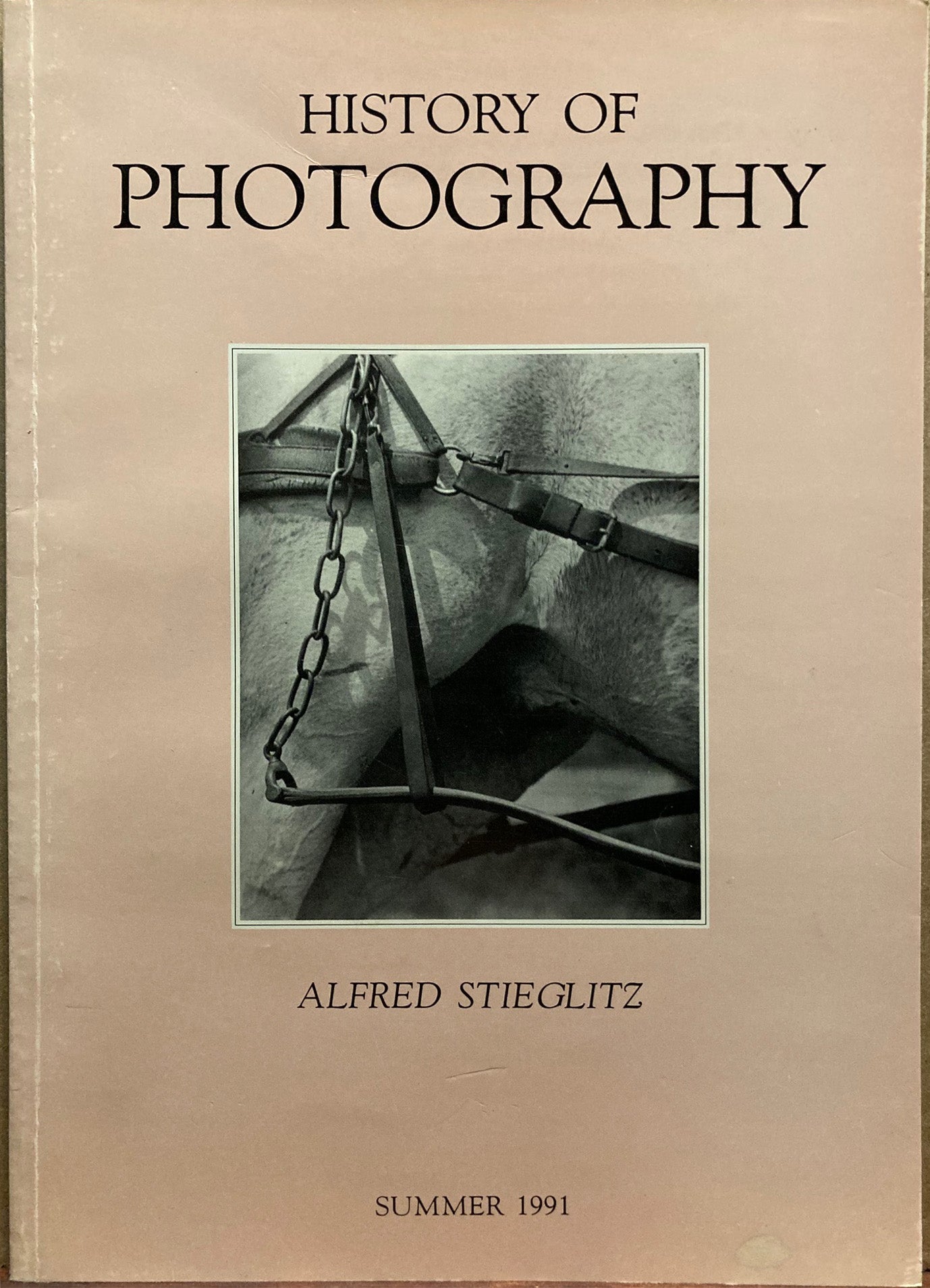
History of Photography, an International Quarterly, 15:2 (Summer 1991). Alfred Stieglitz.
History of Photography, an International Quarterly, 15:2 (Summer 1991). Alfred Stieglitz.
Impossible de charger la disponibilité du service de retrait
Alfred Stieglitz theme issue including Alfred Stieglitz and Lake George by Graham Clarke; Some Uncollected Writings by Stieglitz; Alfred Stieglitz: Catalogue of his Camera Club Exhibition (1899); and Dissertation Abstracts: Alfred Stieglitz and Related Subjects. Also includes Impressionist Theory and the Autochrome by Anne Hammond; Interview: Fred Zimmerman; Portfolio: Photographs of New York (1932) by Fred Zimmerman; On the 'Impurity' of Group f/64 Photography by Michel Oren; Clement Greenberg and Walker Evans by Mike Weaver; Four Photographers (1964) by Clement Greenberg (re Atget, Steichen, Andreas Feininger, and Cartier-Bresson); The Mammoth Camera of George R. Lawrence; et al. Two crimps on rear cover, otherwise fine. Consists of one issue of quarterly journal, for which subscriptions were $554 in 2021. Summary:
The Summer 1991 issue of History of Photography (Volume 15, No. 2) is a scholarly tour de force that primarily re-evaluates the legacy of Alfred Stieglitz, while offering critical revisions of major 20th-century movements and figures.
The Alfred Stieglitz Theme
This section moves beyond the myth of Stieglitz to examine his specific environments, writings, and early reception:
-
Alfred Stieglitz and Lake George (Graham Clarke): An analysis of the pivotal role his family estate played in his work, particularly regarding his "Equivalents" and his portraits of Georgia O’Keeffe.
-
Some Uncollected Writings: A rare primary-source feature bringing lesser-known texts by Stieglitz back into the scholarly conversation.
-
Catalogue of his Camera Club Exhibition (1899): A reproduction of the 1899 catalogue, providing a window into Stieglitz’s early "Pictorialist" phase and his efforts to elevate photography’s status.
-
Dissertation Abstracts: A curated list of academic research reflecting the state of Stieglitz scholarship in the early 1990s.
The Fred Zimmerman Portfolio
The issue highlights the "rediscovery" of Fred Zimmerman, an artist better known as a legendary double-bass player.
-
Interview & Portfolio: Features his 1932 photographs of New York, which capture the city with a gritty, modernist sensibility that aligns with the "Straight Photography" of the era.
Critical Theory and Re-evaluations
-
On the 'Impurity' of Group f/64 (Michel Oren): A provocative essay challenging the traditional view of Group f/64 (Weston, Adams, etc.) as "pure." Oren argues that the movement was actually influenced by commercial interests and political undercurrents.
-
Clement Greenberg and Walker Evans (Mike Weaver): An exploration of the relationship between the influential art critic and the documentary master.
-
Four Photographers (Clement Greenberg): A reprint of Greenberg’s 1964 text, where he applies his rigorous modernist lens to the work of Eugene Atget, Edward Steichen, Andreas Feininger, and Henri Cartier-Bresson.
-
Impressionist Theory and the Autochrome (Anne Hammond): A technical and aesthetic study of how early color "autochromes" were theorized through the lens of Impressionist painting.
Technical History
-
The Mammoth Camera of George R. Lawrence: A fascinating historical account of the world's largest camera—built in 1900 to photograph a train—detailing the extreme engineering required for early 20th-century "super-format" photography.
Core Significance
This issue is essential for its "revisionist" approach. By questioning the "purity" of Group f/64 and contextualizing Stieglitz through his physical locations and early catalogues, the journal bridges the gap between the aesthetic appreciation of photographs and a rigorous, historical critique of the medium.
Biographical Summary of Alfred Stieglitz
Alfred Stieglitz (1864–1946) was a highly influential American photographer, publisher, and gallery director instrumental in establishing photography as a legitimate fine art medium and introducing European avant-garde art to the United States. Born in Hoboken, New Jersey, Stieglitz studied photochemistry under Hermann Wilhelm Vogel at the Technische Hochschule in Berlin, where he began creating atmospheric, sharply observed compositions that challenged the conventional painterly techniques of the day. Returning to New York City, he led the Photo-Secession movement founded in 1902, advocating for Pictorialism and later championing "straight photography"—a pure, unmanipulated approach exemplified by his masterwork The Steerage (1907). As publisher of the influential quarterly Camera Work (1903–1917) and director of pioneering art spaces including Little Galleries of the Photo-Secession (Gallery 291), The Intimate Gallery, and An American Place, Stieglitz showcased groundbreaking modernists such as Auguste Rodin, Pablo Picasso, and Henri Matisse alongside visionaries like Paul Strand and Edward Steichen. His own artistic achievements evolved into deeply expressive, metaphoric series, including his extensive portraits of his wife, painter Georgia O'Keeffe, and his cloud studies known as Equivalents, cementing his position as one of the quintessential architects of 20th-century American visual culture.
