Gary Saretzky Photo Books
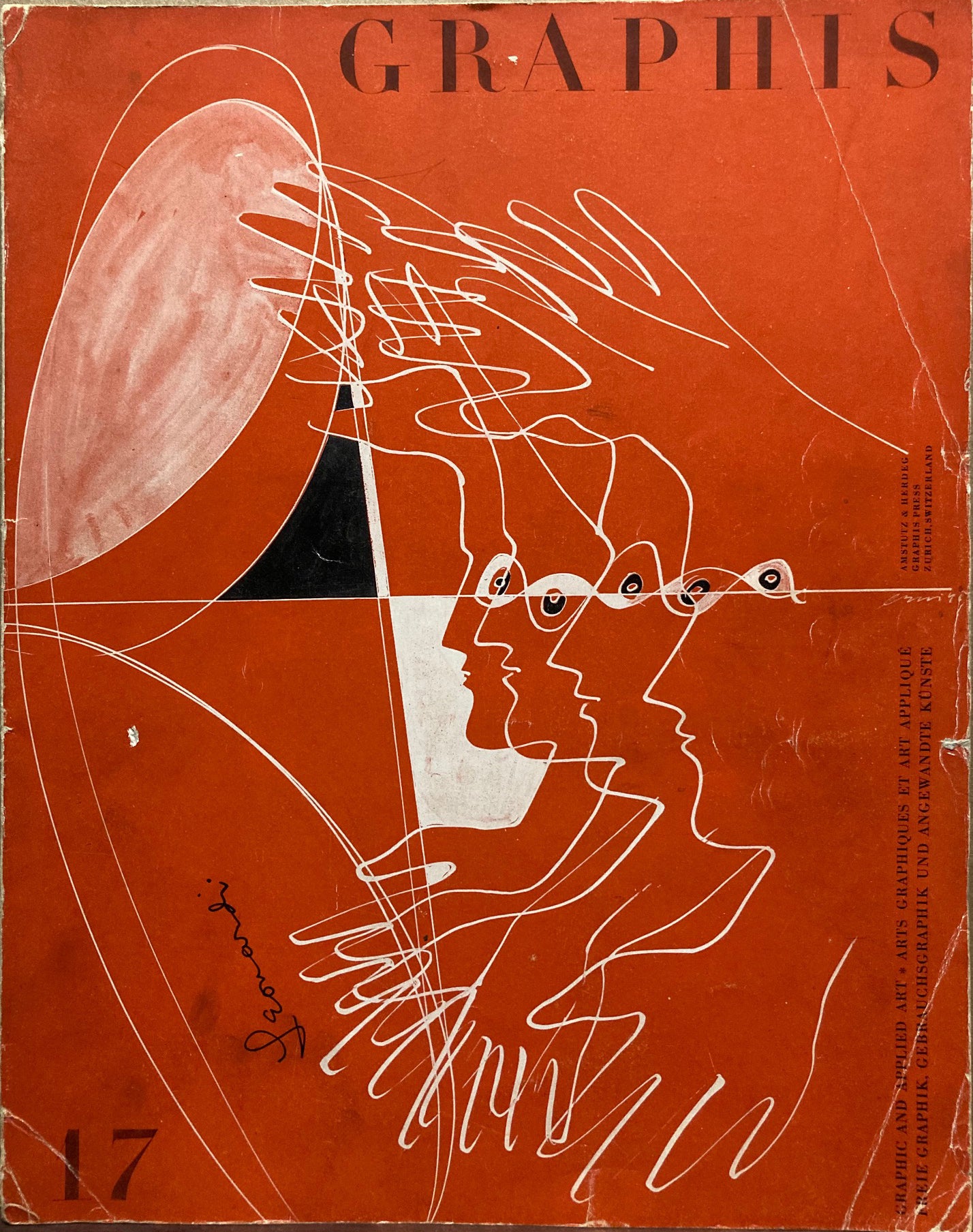
Graphis 17, Volume 3, No. 17, 1947. Graphic design magazine.
Graphis 17, Volume 3, No. 17, 1947. Graphic design magazine.
Impossible de charger la disponibilité du service de retrait
Edited by Dr. Walter Amstutz and Walter Herdeg. Graphis Press, Zurich. Articles in French, English, and German re Savignac, Jean Hugo, Matthew Leibowitz, Jean Carlu, Edward Bawden, Lindi (cartoonist), et al. Does not include features on photography but sample photos and addresses of more than a dozen Swiss photography studios included near the end, including M. Wolgensinger, Hans Tschirren, Jenny, Atelier Eidenbenz, Photo Bettina, Marcel Marrel, Schmutz & Weider, Ada Niggeler, Edmond Droz, et al. Good with covers starting to separate at spine tips. Summary:
Graphis 17 (Volume 3, No. 17, 1947), edited by the legendary Walter Herdeg in Zurich, Switzerland, is a landmark post-WWII issue of the prestigious international journal of graphic art and design. Published with its signature tri-lingual text (English, French, and German), this edition captures the vibrant revitalization of European and American commercial art, avant-garde illustration, and political cartooning immediately following the war.
Key Features and Profiles
-
Raymond Savignac: The issue highlights the emerging brilliance of the French poster master. At this stage in his career, Savignac was beginning to revolutionize advertising with his "distilled humor" and trademark minimalist, joyful characters, paving the way for his iconic post-war commercial successes.
-
Jean Hugo: A deep dive into the work of the French painter, illustrator, and stage designer (and great-grandson of Victor Hugo). The article focuses on his exquisite, poetic book illustrations and miniature gouaches, which married a naive, folkloric style with sophisticated theatricality.
-
Matthew Leibowitz: Representing the vanguard of the American "New Vision," the feature on Leibowitz showcases his aggressive, experimental approach to pharmaceutical and industrial advertising. His work is highlighted for its bold use of photomontage, sharp geometry, and structural typography.
-
Jean Carlu: The journal examines the later work of Carlu, the celebrated French graphic designer who spent the war years in the United States creating iconic propaganda posters (such as "America's Answer! Production"). The article covers his mastery of clean, French stream-lined art deco forms adapted to modern corporate identity.
-
Edward Bawden: A profile of the quintessential English painter and graphic designer. The feature focuses on his distinct linocuts, watercolor illustrations, and commercial designs for companies like Shell-Mex and Fortnum & Mason, celebrating his dry British wit and intricate patterns.
-
Lindi (Albert Lindegger): A compelling feature on the Swiss cartoonist and painter known simply as "Lindi." The article showcases his sharp, satirical, and often bitingly dark political cartoons that skewered fascism, war, and societal hypocrisy with a fluid, expressive ink line.
Editorial and Visual Impact
True to the Graphis ethos, the issue is a masterclass in print production, utilizing various paper stocks, high-fidelity color lithography, and meticulous typography to honor the textures of the original artworks. It acts as an cultural ledger, connecting the disrupted design traditions of pre-war Europe with the booming, media-driven landscapes of post-war America.
Significance
Issue 17 is highly prized by design historians because it documents the rebirth of optimism in visual communication. By putting the playful commercialism of Savignac, the poetic traditionalism of Hugo, and the hard-edged American modernism of Leibowitz under one cover, Herdeg proved that graphic design was the primary global language healing and rebuilding the post-war world.
