Gary Saretzky Photo Books
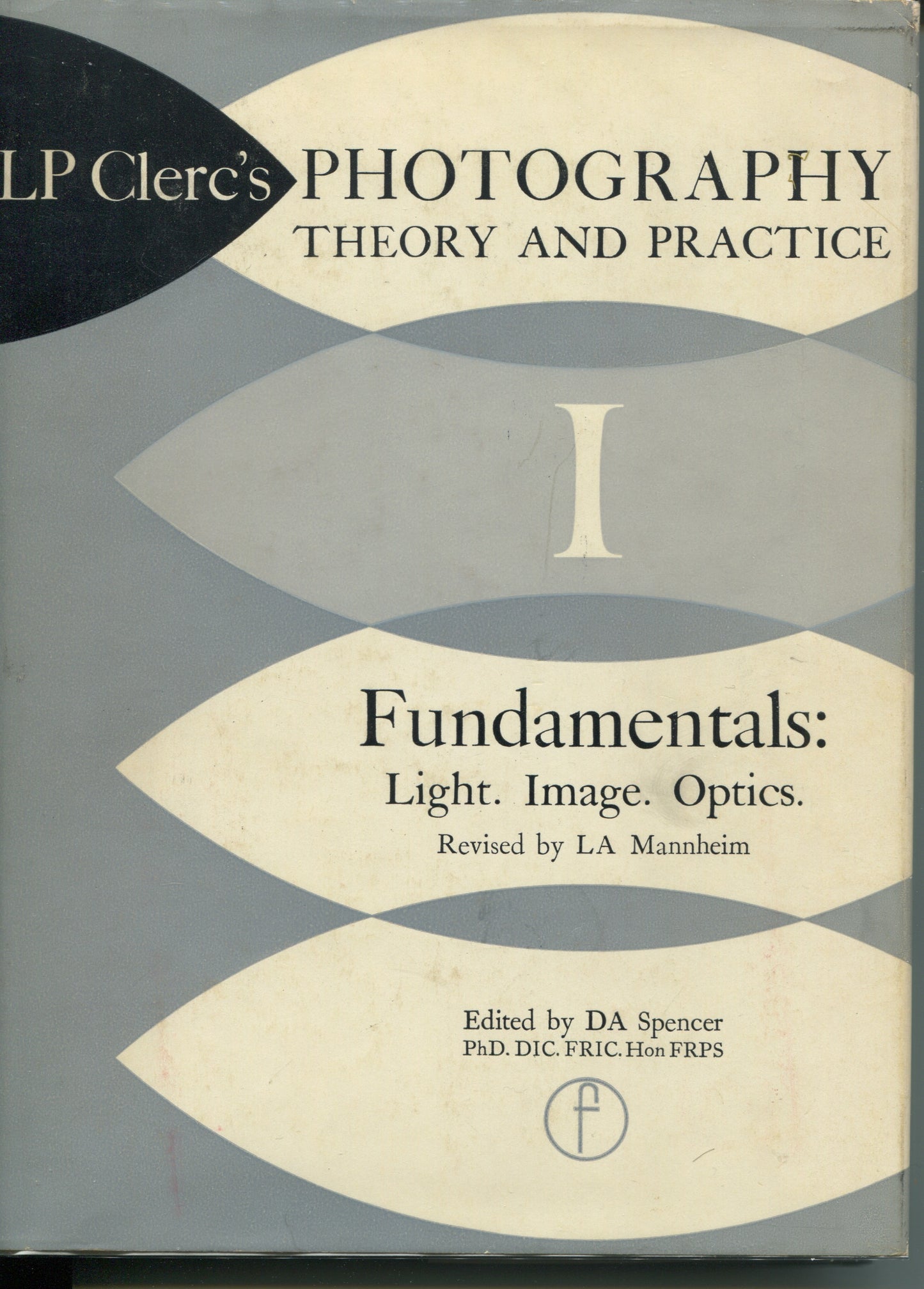
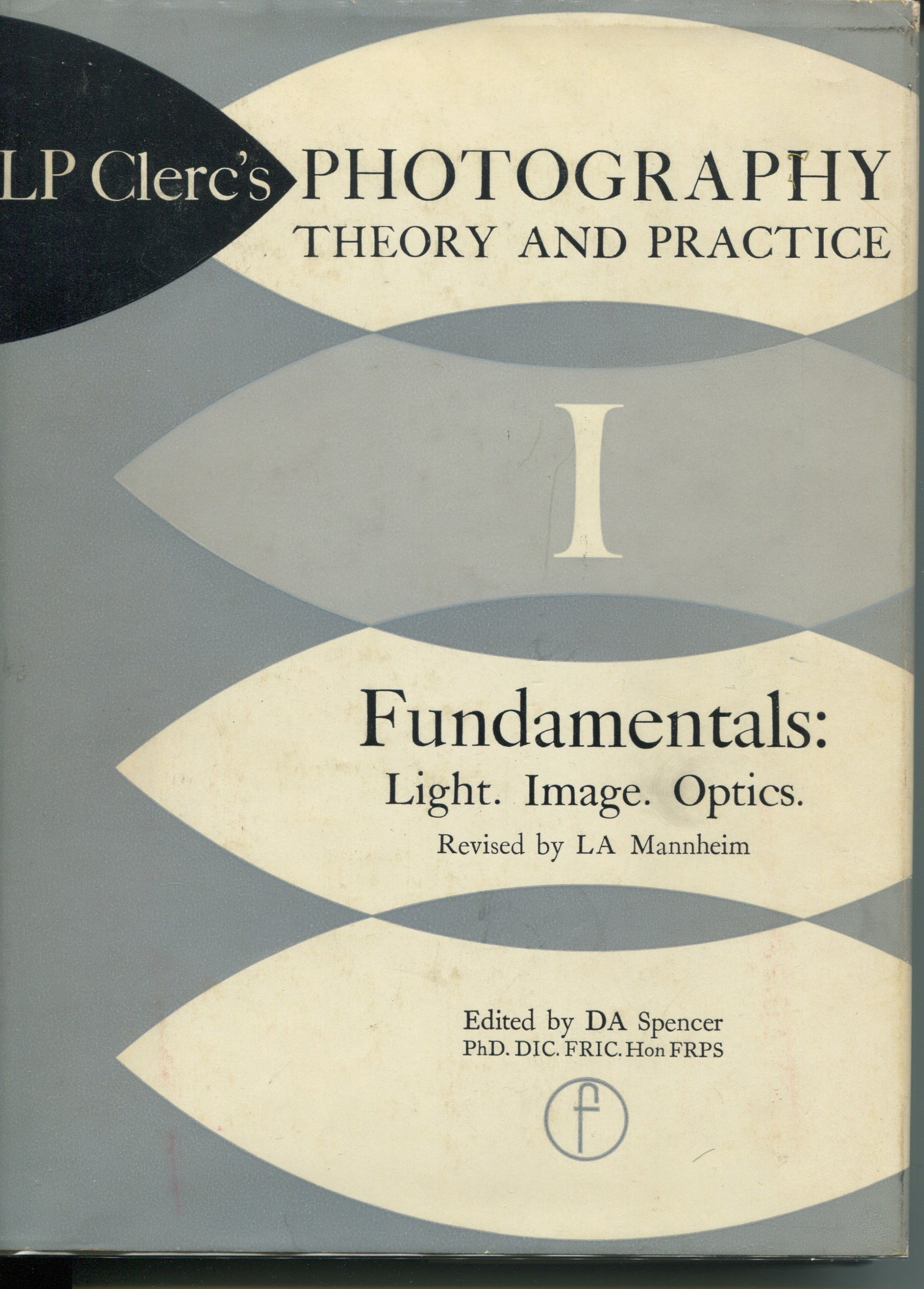
L.P. Clerc's Photography, Theory and Practice: Fundamentals: Light. Image. Optics.
L.P. Clerc's Photography, Theory and Practice: Fundamentals: Light. Image. Optics.
Impossible de charger la disponibilité du service de retrait
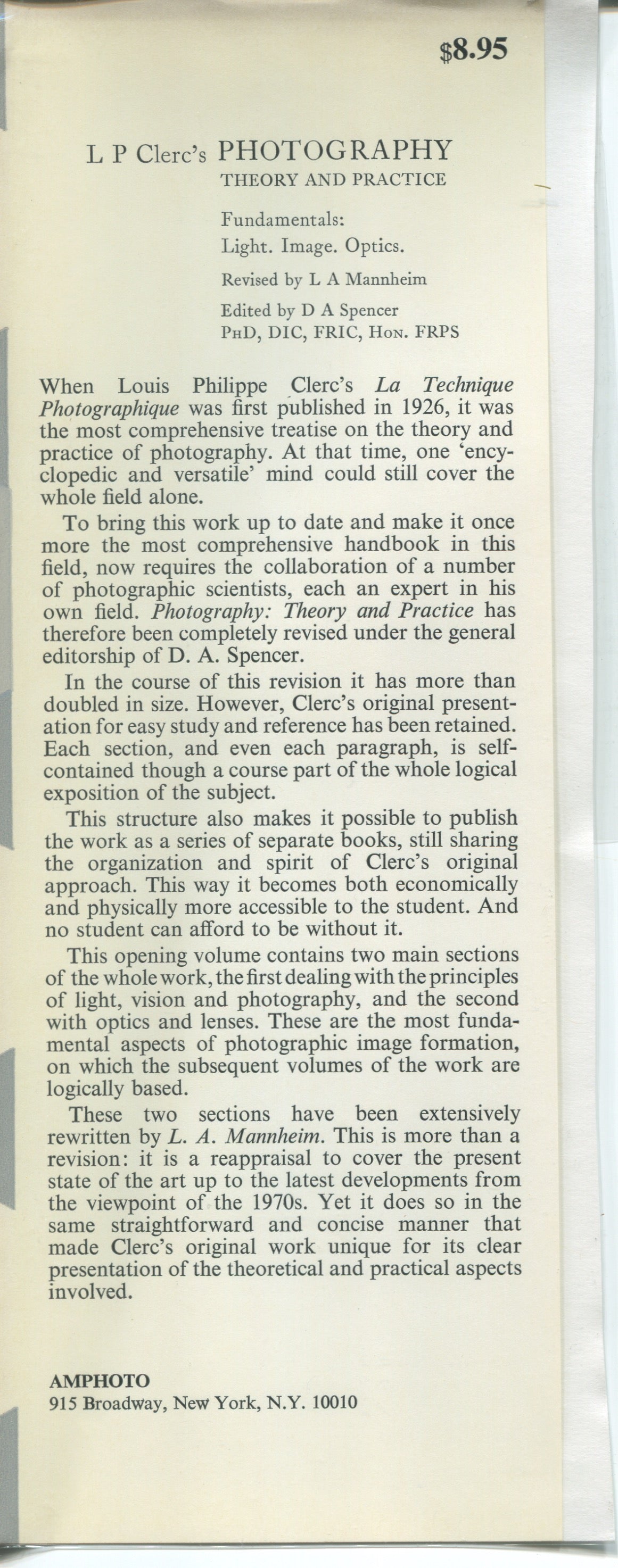
Volume 1 in the series. This volume by L. A. Mannheim. AMPHOTO, 1970. The U.S. edition prepared by Focal Press in the UK. Hardcover in gray cloth, like new with near fine protected dust jacket. Originally published in one volume in 1926 by Louis Philippe Clerc as La Technique Photographique, it was first issued in an English edition in 1930 and reprinted several times. This thorough update and complete revision of his seminal work on photochemistry and related topics required multiple authors and volumes. Here Mannheim provides details in chapters on light and color, quantity of light - photometric units, limits of luminance in photographic subjects, the ideal picture based on scientific criteria, perspective - monocular and binocular vision, principles of color photography, camera obscura and pinhole photography, general properties of optical systems - aberrations, focal length of lenses, diaphragm and related aperture - effect on perspective and intensity, lens types, lens performance, lens accessories, et al. Illustrated with numerous diagrams, charts, etc. This book is quite uncommon in hardcover with dust jacket, even as ex-library copies lacking the dust jacket. Not issued with ISBN number. Library of Congress Catalog Card No. 73-106378. Summary:
L.P. Clerc's Photography, Theory and Practice: Fundamentals: Light, Image, Optics (Revised Edition, 1970) is a cornerstone technical text originally authored by the French polymath Louis Philippe Clerc. This specific volume, edited and updated by D.A. Spencer, serves as the first part of a definitive six-volume series that translates complex physics and chemistry into a comprehensive manual for the professional photographer.
Core Content and Technical Scope
The book focuses on the "First Principles" of photography, providing a rigorous scientific foundation for how images are formed. It is divided into three primary pillars:
-
Light: A deep dive into the properties of electromagnetic radiation, color temperature, and the behavior of light as it interacts with various surfaces and mediums.
-
Image: An exploration of the geometric principles of image formation, covering perspective, depth of field, and the mathematics of "the perfect projection."
-
Optics: A detailed analysis of lens design, including focal lengths, apertures, and the correction of optical aberrations (such as coma, astigmatism, and chromatic aberration).
Style and Purpose
Clerc was known for his "encyclopedic" approach. The manual is characterized by:
-
Scientific Rigor: Unlike modern "how-to" guides, this text utilizes mathematical formulas and physics diagrams to explain why equipment behaves the way it does.
-
Reference Utility: It was designed as a "standard work of reference" for scientists, industrial photographers, and advanced students who required precision over artistic fluff.
-
Historical Continuity: While updated for 1970s technology, it retains the disciplined, classical French pedagogical style that made Clerc the "Grand Old Man" of photographic literature.
Key Information
-
Origins: Originally published in French as La Technique Photographique (1926); this revised English edition was produced by Focal Press.
-
Editor: D.A. Spencer, a leading authority on color photography and technical imaging.
-
Significance: Before the digital revolution, "Clerc" was universally regarded as the most authoritative technical resource in the world. This specific volume remains a vital historical document for understanding the physical laws that govern all camera-based imaging.
Summary: This volume is the "Physics 101" of the photographic world. It strips away the romance of the darkroom to reveal the elegant, uncompromising laws of light and glass that make the medium possible.