Gary Saretzky Photo Books
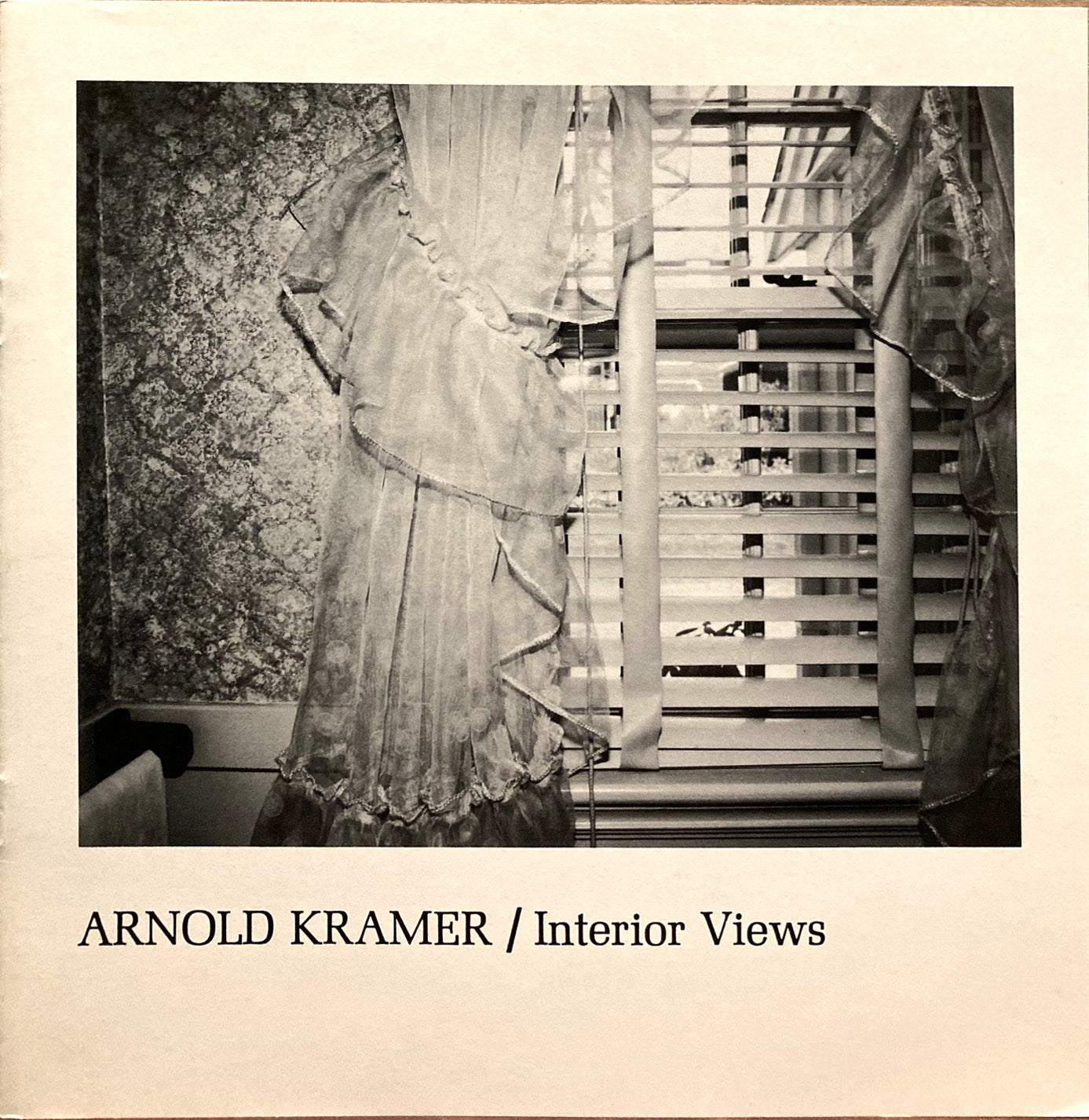
Kramer, Arnold. Arnold Kramer / Interior Views. April 21 - June 4, 1978.
Kramer, Arnold. Arnold Kramer / Interior Views. April 21 - June 4, 1978.
Impossible de charger la disponibilité du service de retrait
Corcoran Gallery of Art, 1978. Essay by Jane Livingston. Photography at the Corcoran Series. 1,500 copies printed. Includes checklist of 26 works and biographical information. Wraps, 12 pages, fine. Summary:
Arnold Kramer / Interior Views (published in 1978 by the Corcoran Gallery of Art) is a slim, highly regarded 12-to-16-page exhibition catalog produced to accompany a pivotal solo exhibition (April 21 – June 4, 1978) by American photographer Arnold Kramer. Featuring an insightful curatorial essay by Jane Livingston, the catalog documents a sophisticated body of black-and-white work that established Kramer as a distinct, analytical talent in late-1970s American photography.
Core Themes and Content
-
Curatorial Analysis of Formal Clarity: In the introductory essay, renowned curator Jane Livingston praises Kramer’s sharp eye for avoiding "romantic bombast" in favor of "formal clarity." Livingston places his work within the broader American lineage of emotionally restrained photography, drawing connections to the clinical, frontal precision of Walker Evans' interior studies while highlighting Kramer's unique modern execution.
-
The Domestic "Collage Effect": The catalog highlights Kramer’s masterful ability to transform random, mundane domestic environments into meticulously structured visual arrangements. Using a wide-angle lens, direct flash, and precise framing, Kramer flattens out overlapping household elements—such as chairs, potted plants, wallpaper patterns, and framed pictures—into complex, three-dimensional visual collages printed on paper.
-
The Banality of Beauty: Capturing settings across Baltimore, Washington D.C., and his hometown of Boston/Cambridge, the featured gelatin silver prints focus heavily on ordinary, middle-class rooms, family room corners, and bureau tops. Through Kramer's lens, these spaces transcend their inherent banality to expose quiet social nuances and ritualistic habits of domestic inhabitation without ever showing the human residents themselves.
-
Engineering and Artistic Pedigree: The publication details Kramer’s background as an MIT-trained electrical engineer whose artistic trajectory was fundamentally shaped by his mentor, Minor White. This technical background manifests in the catalog as a disciplined, almost scientific commitment to print craft, high-key lighting contrast, and structural precision.
By documenting this localized, cerebral approach to indoor spaces, the Corcoran catalog serves as a vital historical marker of the New Topographics era, illustrating how everyday domestic architecture can be analyzed with the cool detachment of a scientist and the composition of a fine artist.
Arnold Kramer (1944–2017) was an acclaimed American photographer, engineer, and educator known for his emotionally restrained, formally precise imagery that captured the quiet complexities of domestic life and historic memory. Born in Cambridge, Massachusetts, Kramer pursued a rigorous academic path at the Massachusetts Institute of Technology, earning undergraduate and graduate degrees in electrical engineering by 1968. It was at MIT that he met the legendary photographic master Minor White, who became his mentor and deeply influenced Kramer's synthesis of high technical precision with acute visual intuition. Settling in the Washington, D.C. area, Kramer balanced careers as a photography lecturer at the University of Maryland School of Architecture and as a flourishing commercial and architectural photographer throughout the 1970s and 1980s. He earned wide critical recognition—and two fellowships from the National Endowment for the Arts—for his celebrated series Interior Views, which debuted at the Corcoran Gallery of Art in 1978 and masterfully transformed ordinary, middle-class household settings into evocative, geometric visual collages. In 1987, Kramer transitioned into a prolonged, meaningful tenure at the United States Holocaust Memorial Museum, serving as its staff photographer, head of information technology, and senior project advisor, notably creating powerful, large-scale portrait projections of Holocaust survivors. Represented in prestigious permanent collections including the National Gallery of Art, the Smithsonian American Art Museum, and the Baltimore Museum of Art, Kramer remains celebrated as a distinct talent who brilliantly balanced an engineering commitment to craft with a profound commitment to seeing.
