Gary Saretzky Photo Books
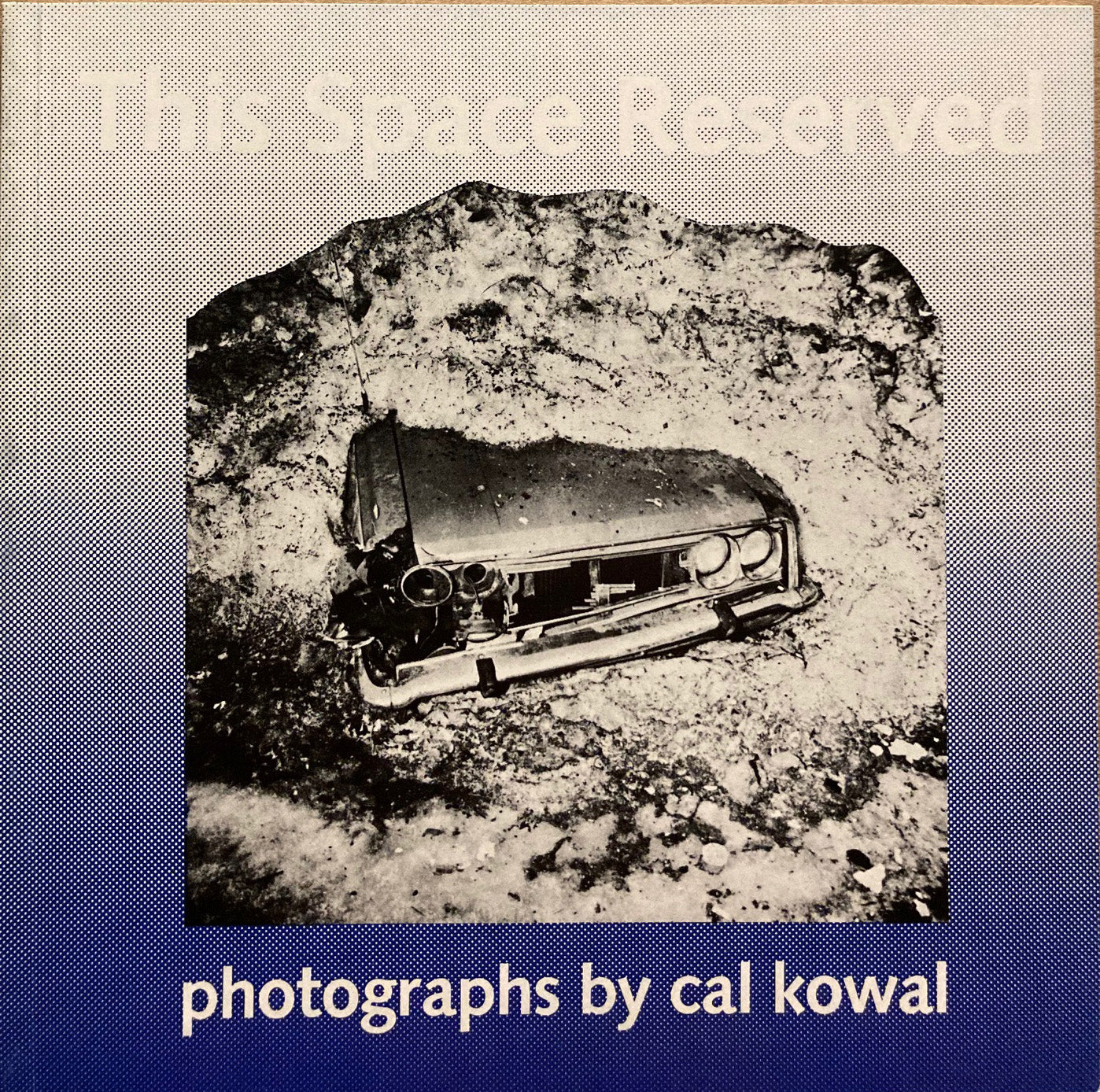
Kowal, Cal. This Space Reserved by Cal Kowal.
Kowal, Cal. This Space Reserved by Cal Kowal.
Impossible de charger la disponibilité du service de retrait
Self-published, 1980, unpaginated. Wraps, artist’s book of photographs of ways people reserved parking spaces in Chicago in Winter 1979. Fine with small spot on bottom edge of text block. Summary:
This Space Reserved (self-published in 1980) is an unpaginated, limited-edition photographic artist's book created by American conceptual photographer and educator Cal Kowal. Shifting away from standard fine art landscapes, the square, softcover volume serves as a charming and witty anthropological documentation of a uniquely urban winter ritual, capturing how everyday civic spaces are temporarily claimed through the lens of human territoriality.
Core Themes and Content
-
Documenting "Dibs" Culture: The entire structural premise of the book focuses on the seasonal phenomenon commonly known in Chicago as "dibs." Kowal meticulously documents the humorous, creative, and sometimes fiercely territorial practices of city residents who utilize an absurd array of household items to reserve street parking spaces they have painstakingly shoveled out following severe winter blizzards.
-
The Sculpture of Survival: Across a series of high-contrast, black-and-white photographs taken during the brutal Chicago winter of 1979, Kowal frames these crude parking markers as impromptu, readymade sculptures. The images showcase a bizarre, deadpan inventory of discarded domestic artifacts placed in the snow bank clearings, ranging from broken lawn chairs and wooden crates to plastic buckets, old milk crates, and broken furniture.
-
An Analysis of Urban Commons: Beneath its humorous surface, the book operates as a fascinating sociological case study on communal negotiation, public space, and unwritten neighborhood laws. Kowal’s framing highlights how a shared natural crisis temporarily suspends normal municipal codes, replacing them with an informal, citizen-enforced social contract where an object as mundane as an upside-down trash can suddenly commands absolute spatial authority.
-
The Aesthetic of the Bleak Winter: Visually, the publication leans into the harsh, washed-out tones of a Midwestern winter. The high-contrast printing emphasizes the heavy, gray slush, stark asphalt, and bright white snowdrifts, contrasting the bleak urban landscape against the highly eccentric shapes of the personal property left behind to guard the open asphalt.
By transforming a routine neighborhood frustration into a poetic visual archive, This Space Reserved stands as a definitive, lighthearted testament to Cal Kowal’s ability to find compelling, sculptural performance art in the ordinary rhythms of mid-century American city life.
Cal Kowal (born 1944) is an acclaimed American conceptual photographer, multimedia artist, and educator known for his inventive, humorous, and socially insightful approach to capturing contemporary culture. Born in Chicago, Kowal received a BA in art and architectural history from the University of Illinois, Chicago, before earning an MS in design from the prestigious Institute of Design at the Illinois Institute of Technology, where he studied under legendary photographic figures Aaron Siskind and Arthur Siegel. Combining technical discipline with a sharp eye for the unconventional, he established a prolific career that bridged fine art photography with graphic and performance elements, famously illustrated by his 1980 artist's book This Space Reserved, which documented Chicago's winter parking "dibs" culture. Beyond his studio practice, Kowal dedicated over thirty years to academia, serving as a Professor of Fine Art at the Art Academy of Cincinnati from 1971 until his retirement in 2002. The recipient of multiple visual arts fellowships from the Ohio Arts Council and a Kodak Fellowship, Kowal's boundary-pushing works are held in premier permanent collections worldwide, including the Museum of Modern Art (MoMA), the Art Institute of Chicago, the George Eastman House, and the Museum of Contemporary Photography.
