Gary Saretzky Photo Books
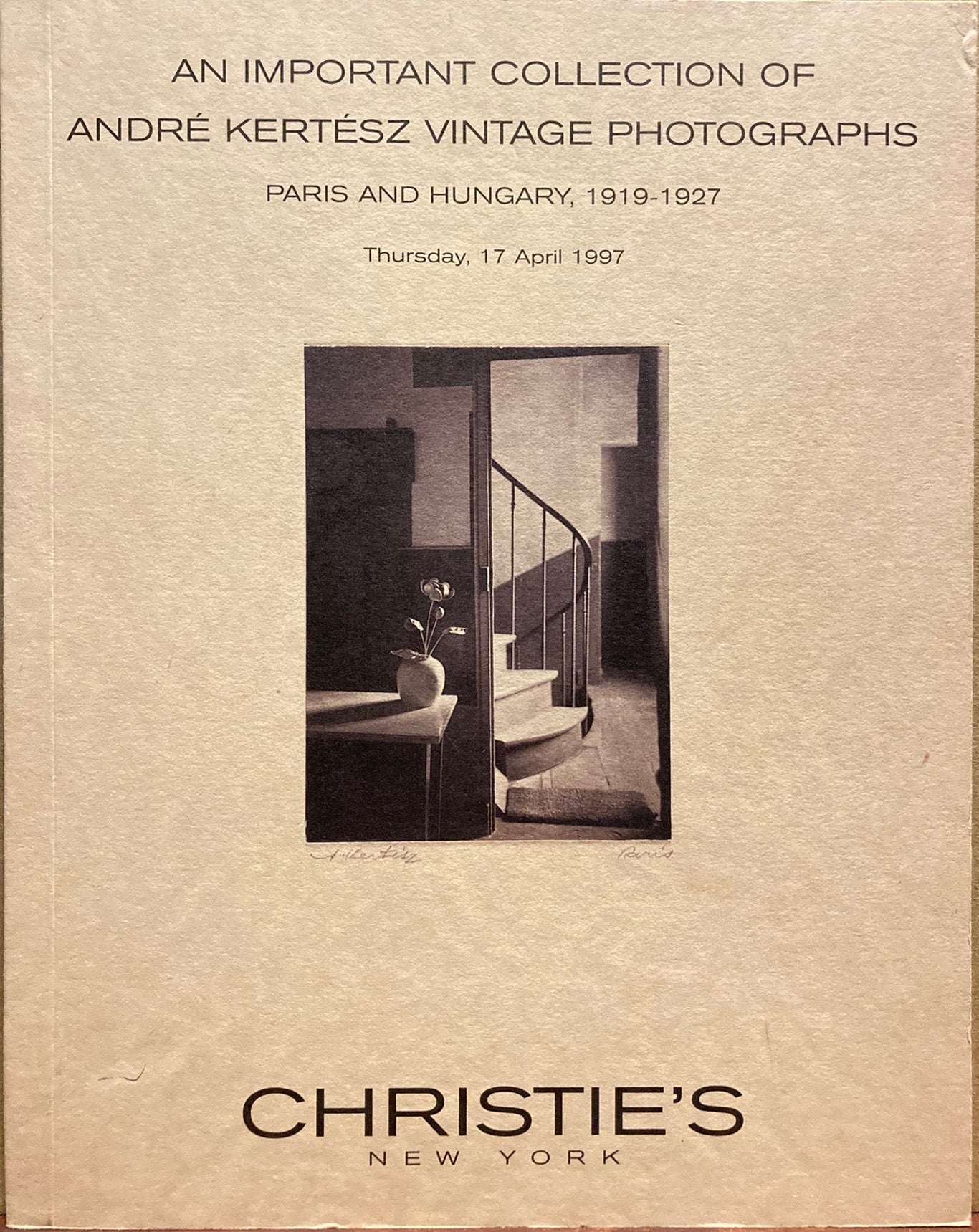
Kertesz, Andre. An Important Collection of Andre Kertesz Vintage Photographs. Paris and Hungary, 1919-1927.
Kertesz, Andre. An Important Collection of Andre Kertesz Vintage Photographs. Paris and Hungary, 1919-1927.
Impossible de charger la disponibilité du service de retrait
Christie’s New York. Thursday, 17 April 1997. Lots 172-208. Wraps, unmarked, very good with small bump on top right edge. [Collection of Jane Corkin. Includes extensive notes about Kertesz and his exceptional photographs, including some of the best known in the history of photography such as "Chez Mondrian."]
André Kertész (1894–1985) was a pioneering Hungarian-born American photographer celebrated for his lyrical, unmanipulated imagery and his groundbreaking contributions to photographic composition, street photography, and the photo essay. Born Andor Kertész in Budapest, he initially worked as a clerk at the local stock exchange while teaching himself photography, creating intimate depictions of daily life and moving portraits of soldiers while serving in the Austro-Hungarian army during World War I. Seeking greater artistic opportunities, Kertész moved to Paris in 1925, where he became a cornerstone of the interwar avant-garde scene, making portraits of icons like Piet Mondrian and Colette while serving as a lead photographer for the trailblazing illustrated magazine Vu. In 1928, he became one of the first major artists to adopt the handheld 35mm Leica camera, using its mobility to capture unexpected street juxtapositions, shadows, and reflections that proved photography could be considered a fine art. Fleeing the rise of Nazism, Kertész emigrated to New York City in 1936, where his poetic sensibility initially clashed with the commercial demands of American magazines, leading to a long, frustrating period shooting architecture for Condé Nast's House & Garden. His career was dramatically reawakened in 1964 with a major solo retrospective at the Museum of Modern Art (MoMA), cementing his legacy as a mentor to masters like Henri Cartier-Bresson and Brassaï, and securing his status as one of the most influential and poetic visual voices of the 20th century.
