Gary Saretzky Photo Books
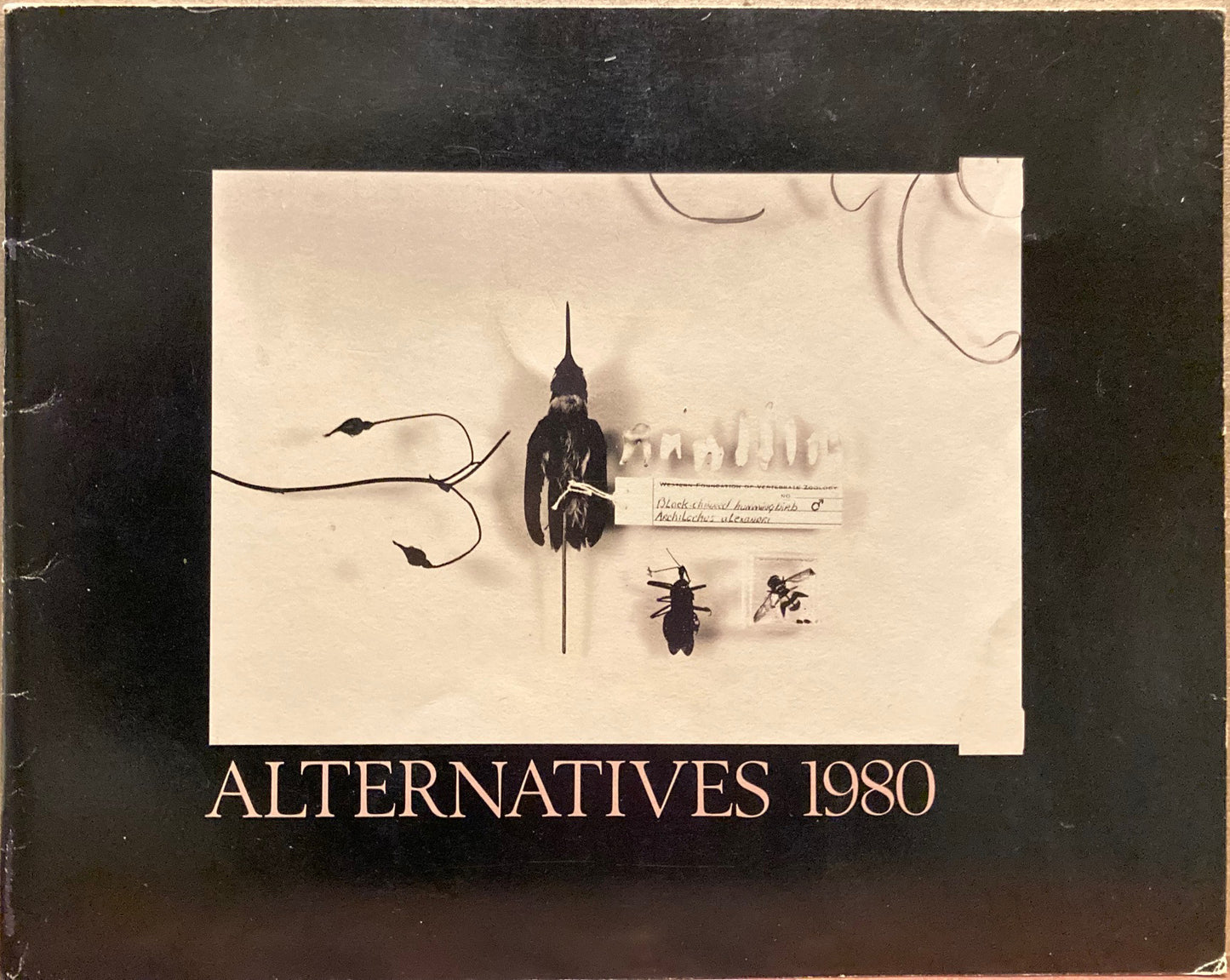
Alternatives 1980. Essay by Mark Schwartz, Director.
Alternatives 1980. Essay by Mark Schwartz, Director.
Impossible de charger la disponibilité du service de retrait
Catalog for photography exhibition, Seigfred Gallery, Ohio University, February 18 to March 3, 1980, and which traveled to Ohio State University, Columbus, and Spaces Gallery, Cleveland. 32 pages with color and black-and-white reproductions of a selection of the work, with complete list in the back. Features mostly manipulative printing or nonstandard presentations using postvisualisation techniques. Juror awards to photographers, most of whose work is illustrated, included Robert A. Widdicombe; Robert Stiegler; Christina Hutton; Eric Lansberg; Philip E. Wakeman; Barbara De Genevieve; Carl Baden; Paul Berger; Frances Murray; Diana Schoenfeld; Ruth Terrill; Celia Jordan; Carol Porter McClintock; John Ganis; Paula Crane; and James Chressanthis. Others illustrated include Larry S. Ferguson, Tim Dowling; Philip E. Wakeman; Ronald J. Jacomini; Carl Baden; and Sandra Yoshie. Summary:
Alternatives 1980 is the seminal exhibition catalog documenting a national juried competition held at Ohio University's Seigfred Gallery. This specific edition is celebrated for capturing a "tectonic shift" in American photography—the moment when the medium moved definitively away from traditional "straight" documentation and toward experimental, manipulated, and conceptual processes.
Core Concept: The "Alternative" Aesthetic
As the title suggests, the exhibition was a showcase for photographers who rejected the purist "f/64" tradition of the previous generation. The works featured were not merely "taken" but "made," utilizing a variety of non-silver and post-capture techniques.
-
The Rejection of Modernism: The catalog reflects a move toward Postmodernism, where the photograph is treated as a constructed object rather than a transparent window into reality.
-
Process over Subject: Many of the featured artists prioritized the physical manipulation of the print—hand-coloring, collage, solarization, and the use of archaic 19th-century processes (like cyanotype and van dyke brown) to achieve contemporary ends.
Mark Schwartz’s Essay: Defining the Moment
In his introductory essay, Mark Schwartz (then Director of the Seigfred Gallery) provides a critical framework for the "Alternative" movement.
-
The Pluralistic Decade: Schwartz argues that the 1980s began with an explosion of styles. He notes that the "correct" way to make a photograph no longer existed, replaced by a "pluralism" that welcomed art school experimentation and mixed-media approaches.
-
Photography as Language: Schwartz discusses the shift from photography as a "record" to photography as a "language"—a tool for expressing internal psychological states or deconstructing cultural myths rather than simply documenting the exterior world.
Key Themes and Techniques
The catalog documents a wide array of experimental techniques that were gaining mainstream art-world traction in 1980:
-
Hand-Coloring and Painting: The use of oils, pencils, and dyes on top of gelatin silver prints to blur the line between photography and painting.
-
Sequence and Narrative: Photographers using multiple frames to tell non-linear or dreamlike stories, moving away from the "decisive moment."
-
Conceptual Construction: Studio-based work where the photographer builds elaborate tableaus or "sets" specifically to be photographed.
Significance
Alternatives 1980 is an essential historical marker for the academicization of photography. Because the show was hosted by a major university gallery, it highlights the role that art schools played in pushing the medium into new, often controversial territories.
For scholars, this catalog serves as a "time capsule" of the specific avant-garde energy that defined the early 1980s, showcasing a generation of artists who were eager to break the rules of their predecessors to find a more personal, visceral visual voice.
"The 'Alternative' is no longer the exception; it has become a vital part of the new photographic mainstream." — Mark Schwartz