Gary Saretzky Photo Books
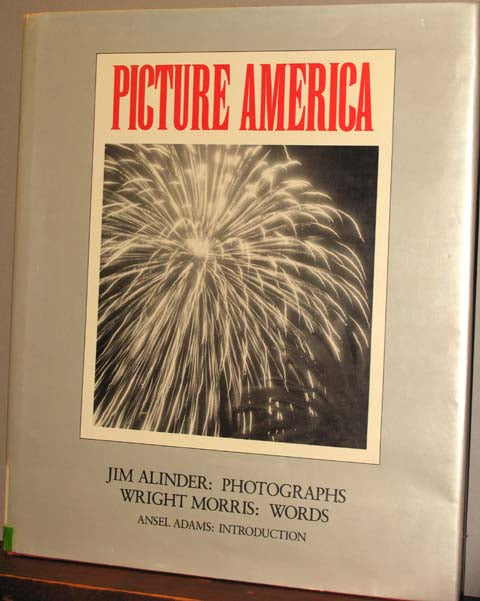
Alinder, Jim. Picture America. Photographs by Jim Alinder. Text by Wright Morris.
Alinder, Jim. Picture America. Photographs by Jim Alinder. Text by Wright Morris.
Impossible de charger la disponibilité du service de retrait
Introduction by Ansel Adams. 55 duotone illustrations. New York Graphic Society/Little Brown, 1982. 1st ed. A fine ex-library copy with dust jacket protector taped to book. Summary:
Picture America, published by Aperture in 1982, is a unique collaborative effort that pairs the photography of Jim Alinder with the prose of National Book Award-winning author Wright Morris. Far from a standard "travelogue," the book is a sophisticated, often witty, and deeply nostalgic exploration of the American vernacular.
Core Concept: The "Bifocal" Vision
The book functions as a dialogue between two Nebraskans. Jim Alinder provides the visual data of the American landscape—the diners, the Main Streets, and the quirky monuments—while Wright Morris provides "textual snapshots" that do not describe the photos directly, but rather echo their mood and irony.
-
The Anti-Spectacular: The book avoids the "Grand Canyon" style of American photography. Instead, it focuses on what Morris calls the "uncommonplaces"—the small, often overlooked details that define the national character.
-
A Shared Aesthetic: Both Alinder and Morris share an interest in the "texture of time." They look for the ways that history is written on the sides of buildings, in the arrangements of shop windows, and in the faces of people in small-town parades.
Visual Style and Themes
-
Jim Alinder’s Photography: Alinder uses a sharp, clean, large-format aesthetic. His images are often characterized by a "frontal" perspective, looking directly at subjects with a mix of affection and deadpan humor.
-
Subjects: Backyard statues, expansive plains, neon signs, and the quiet dignity of elderly Americans.
-
-
Wright Morris’s Text: As a photographer himself, Morris’s writing is famously visual. His contributions in Picture America act as "fictional truths," providing a narrative soul to Alinder’s silent scenes. He captures the voice of the Midwest—dry, observant, and subtly poetic.
Key Themes: The Irony of the American Dream
-
The "Lived-In" Landscape: The book captures America as a place that is constantly being built, abandoned, and repurposed. It finds beauty in the sagging porch and the faded billboard.
-
Cultural Artifacts: Alinder treats roadside attractions and local festivals as modern-day folklore, documenting how Americans express their identity through the objects they create and the spaces they inhabit.
-
The Continuity of the West: While the frontier is long gone, the book suggests its spirit survives in the vast, empty spaces between towns and the stubborn independence of the people photographed.
Significance
Picture America is celebrated as a high-water mark for the photo-text genre. It arrived during a period of "Americana" revival, but it avoided the trap of sentimentality. By combining Alinder’s "straight" documentary eye with Morris’s literary depth, the book offers a complex, multi-layered portrait of a country that is both ordinary and extraordinary.
"We are looking at what we have made of ourselves, and what time has made of what we have made." — Summary of the Alinder/Morris collaboration.
Jim Alinder (1941–2023) was an influential American photographer, educator, author, and arts administrator who played a key role in shaping post-war photographic culture. After earning a Master of Fine Arts degree in photography from the University of New Mexico and spending a decade teaching art at the University of Nebraska, Alinder moved to Carmel, California, in 1977 at the invitation of Ansel Adams to serve as the executive director of The Friends of Photography, expanding it into a premier national nonprofit institution. As an artist, Alinder was celebrated for his versatile, innovative visual style—ranging from creative experimentation with plastic Diana and Kodak Instamatic cameras to intimate, observation-driven 150-degree panoramic imagery using a swinging-lens Widelux camera. Over the course of his career, he wrote or edited dozens of books, curated over 150 exhibitions, operated the Alinder Gallery in Gualala alongside his wife, Mary, and earned recognition with multiple National Endowment for the Arts fellowships, leaving an enduring legacy as both a creative practitioner and a champion of the medium.