Gary Saretzky Photo Books
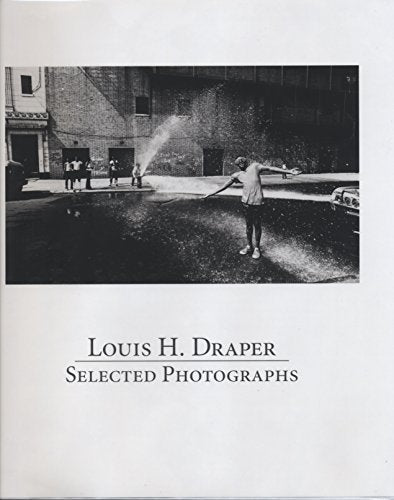
Draper, Louis H. Louis H. Draper: Selected Photographs.
Draper, Louis H. Louis H. Draper: Selected Photographs.
Impossible de charger la disponibilité du service de retrait
Edited by Margaret O'Reilly with essays by Gary D. Saretzky and Iris Schmiesser. Booksmart Studio & Mercer County Community College, 2015. ISBN-978-1-939026-00-2. Monograph on the esteemed Black photographer Louis H. Draper (1935-2002), a co-founder of the Kamoinge Group established in the 1960s to document Harlem and later the coordinator of the photography program at Mercer County Community College, NJ.] Cloth bound with photo mounted on cover, plus dust jacket. Issued in a limited edition of 1,500. 124 pages with numerous full page black-and-white illustrations, with a selection of Draper's photographs of the city, portraits, and abstractions. Includes chronology and other biographical information in appendices. New in original shrink wrap. Also available signed by Saretzky, for which the shrink wrap will be opened before shipping. Summary:
Louis H. Draper: Selected Photographs (published in 2015 by Booksmart Studio and Mercer County Community College) is a focused monograph celebrating the profound artistic vision, structural precision, and educational legacy of African American photographer Louis H. Draper. Serving as a crucial catalog for his work, the publication highlights Draper’s vital contributions to twentieth-century American photography, particularly his role as a foundational leader of the historic Kamoinge Workshop in New York City.
Core Content & Creative Framework
1. The Kamoinge Philosophy and the Black Aesthetic
A central pillar of the publication is its exploration of Draper's leadership within the Kamoinge Workshop, an influential collective of Black photographers formed in Harlem in 1963. The text details how Draper, alongside peers like Roy DeCarava and Beuford Smith, sought to reclaim the visual narrative of Black communities. The curated photographs demonstrate a commitment to depicting the everyday realities, dignity, and beauty of African American life with absolute honesty, directly countering the sensationalized, stereotypical, or patronizing imagery prevalent in mainstream mid-century media.
2. Formal Abstraction and Geometric Mastery
The monograph places significant emphasis on Draper's formal technical mastery, highlighting that he was not merely a documentary chronicler but a dedicated formal modernist. The selected plates showcase his sophisticated use of light, shadow, and geometric design:
-
Street Abstractions: Images of urban Harlem and New York City where storefronts, fire escapes, and sidewalk reflections are used to construct intricate, abstract patterns.
-
Chiaroscuro and Tonality: Photographs that utilize deep, rich blacks and piercing highlights to create intense psychological depth and dramatic tension within quiet, everyday scenes.
3. Global Humanism and Portraiture
Beyond his celebrated New York street photography, the catalog compiles Draper’s expansive travel and portrait work, tracking his journey through a global humanist lens. The volume features powerful portraits of prominent cultural and civil rights icons—such as Malcolm X, Miles Davis, and Langston Hughes—alongside intimate, respectful depictions of ordinary citizens photographed during his travels to Senegal, Europe, and the American South. These images underscore Draper's ability to capture the profound interiority and quiet strength of his subjects across geographic and social boundaries.
4. The Educator's Lens and Preservation
The publication honors Draper's extensive tenure as a beloved professor of photography at Mercer County Community College, where he taught for nearly three decades and influenced generations of emerging artists. The text contextualizes how his rigorous academic standards and deep knowledge of photographic history shaped his teaching philosophy. By gathering these selected images, the catalog acts as an essential archival record, preserving his lifelong dedication to treating photography as both a high art form and a vital tool for social truth.
Louis H. Draper: Selected Photographs represents a critical early milestone in the ongoing scholarly effort to cement Draper's rightful place in the canon of American art. By centralizing his dual legacy as an avant-garde formalist and a champion of Black visual autonomy, this monograph serves as an indispensable reference text for understanding the mid-century photographic vanguard and the radical history of the Kamoinge Workshop.
Notes: Photographer and co-founder of the Kamoinge group of Black photographers in New York in the early 1960s, Lou Draper was born in Richmond, Virginia, on September 24, 1935. He attended Virginia State College, then studied photography in New York with Harold Feinstein and W. Eugene Smith, for whom he became an assistant. Draper first came to national attention in the exhibition, Photography at Mid-Century (1959), at the International Museum of Photography at the George Eastman House. He was included in the first Black Photographers Annual in 1973 and in the 1975 Kamoinge exhibit at the International Center for Photography. In 2021, Draper was featured in the exhibit, “Working Together: The Photographs of the Kamoinge Workshop” at the Whitney Museum of American Art that originated at the Virginia Museum of Fine Arts, which makes Draper’s archives available online and published an impressive exhibit catalog. From 1982 until his death. Draper taught photography and coordinated the photography curriculum at Mercer County Community College in New Jersey. In the catalog for his show at Rider University in 1990, Draper stated, "Expressing yourself is really a by-product of expressing your subject. And in expressing your subject there is a coming together of those experiences that shape you and cause you to select a particular kind of material with which to work. I am concerned primarily with photography's evocative and lingering after-presence -- that undefined questioning and reexamination of my environment.” Museums that hold Draper's photographs include the Virginia Museum of Fine Arts, George Eastman Museum, Whitney Museum of Art, Philadelphia Museum of Art, Museum of Fine Arts, Boston, Nasher Museum of Art at Duke University, Smithsonian American Art Museum, Detroit Institute of Art, Carnegie Museum of Art, Nelson-Atkins Museum, Cleveland Museum of Art, Baltimore Museum of Art, National Museum of African American History and Culture, et al. For more information on Draper, see http://lens.blogs.nytimes.com/2013/08/05/glossed-over-no-more-louis-drapers-archive ].