Gary Saretzky Photo Books
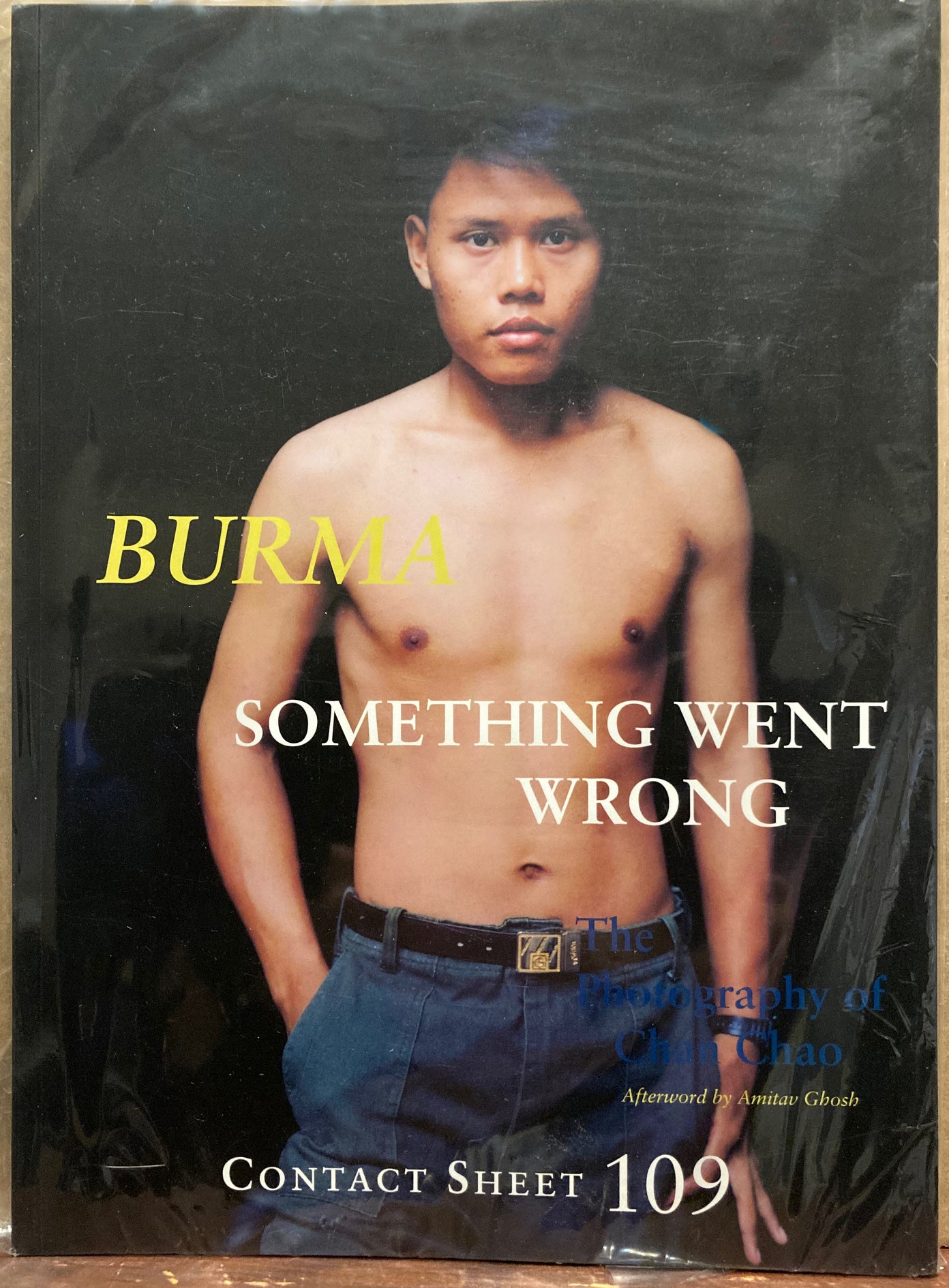
Chao, Chan. Burma: Something Went Wrong by Chan Chao.
Chao, Chan. Burma: Something Went Wrong by Chan Chao.
Impossible de charger la disponibilité du service de retrait
Oversize monograph, illustrated stiff wraps with French flaps, 127 pages, issued as Contact Sheet 109. Syracuse: Light Work, 2000. Fine. Summary:
Burma: Something Went Wrong (published in 2000 by Nazraeli Press / Light Work) is a photographic monograph documenting Chan Chao’s journey to reconnect with his native homeland. After being denied an official entry visa by the Burmese government, Chao traveled to the remote, dense border regions of Thailand and India between 1996 and 1998. There, he photographed refugees, pro-democracy insurgents, soldiers, and ordinary individuals displaced by the nation's ongoing military conflict. Rather than focusing on violent conflict or explicit political rebellion, Chao utilized natural light and simple, intimate portraiture against lush, vibrant landscapes to capture the dignity, humanity, and everyday reality of his subjects. The project serves as a stark juxtaposition between the intrinsic natural beauty of the region and the social and political devastation that has plagued the country.
Chan Chao (born 1966 in Kalemyo, Burma) is a Washington, D.C.–based photographer and educator. His family emigrated from Burma to the United States in 1978, where he later studied photography at the University of Maryland under fine art photographer John Gossage. Recognized for his striking, naturally lit portraiture in regions marked by geopolitical tension, Chao gained widespread acclaim when portraits from his Burma: Something Went Wrong series were featured in the 2002 Whitney Biennial. In addition to publishing several monographs—including Burma: Something Went Wrong, Letter from PLF, Echo, and Two Places on Earth—he has taught photography at institutions such as George Washington University and the Corcoran College of Art and Design. His work is represented in major permanent museum collections across the United States, including the National Gallery of Art, the Whitney Museum of American Art, the Hirshhorn Museum and Sculpture Garden, and the San Francisco Museum of Modern Art.
Jeffrey Hoone writes in the accompanying essay: "Chan Chao's family left Burma for the United States when he was 12 years old. Eighteen years later Chao returned to Burma with the intention of rediscovering and reconnecting with the culture and people he had left years before. Twice denied a visa by the Burmese government, Chao eventually made his way to the Thai-Burmese border where students had established several camps to launch guerrilla attacks against the military regime that controlled Burma with the goal of restoring democracy to the country. With the knowledge that Burma's military junta is one of the world's worst human rights violators, Chao's portraits are remarkable for the sense of calm and tenderness that he draws out of each of his subjects. Each portrait is made from an intimate distance, generously placing each subject in the center of the frame surrounded by the soft focus of the lush jungle beyond. In many of his portraits the subjects hold simple objects: a sickle, a saw, a large piece of fruit, a live chicken. These simple objects provide an elegant solution to the problem of portraiture where individuals are often unsure of what to do with their hands, and in that uncertainty convey stiff and formal poses. But the objects are also disarming because they signal the activities of a simple agrarian life, not one of armed resistance. This contradiction plays heavily into the power that each image conveys, because each person that Chao photographs displays a remarkable range of honesty and emotion that seems to long for a return to the simple pleasures of family, work, and relaxation--not another night of firing rockets or setting land mines."
