Gary Saretzky Photo Books
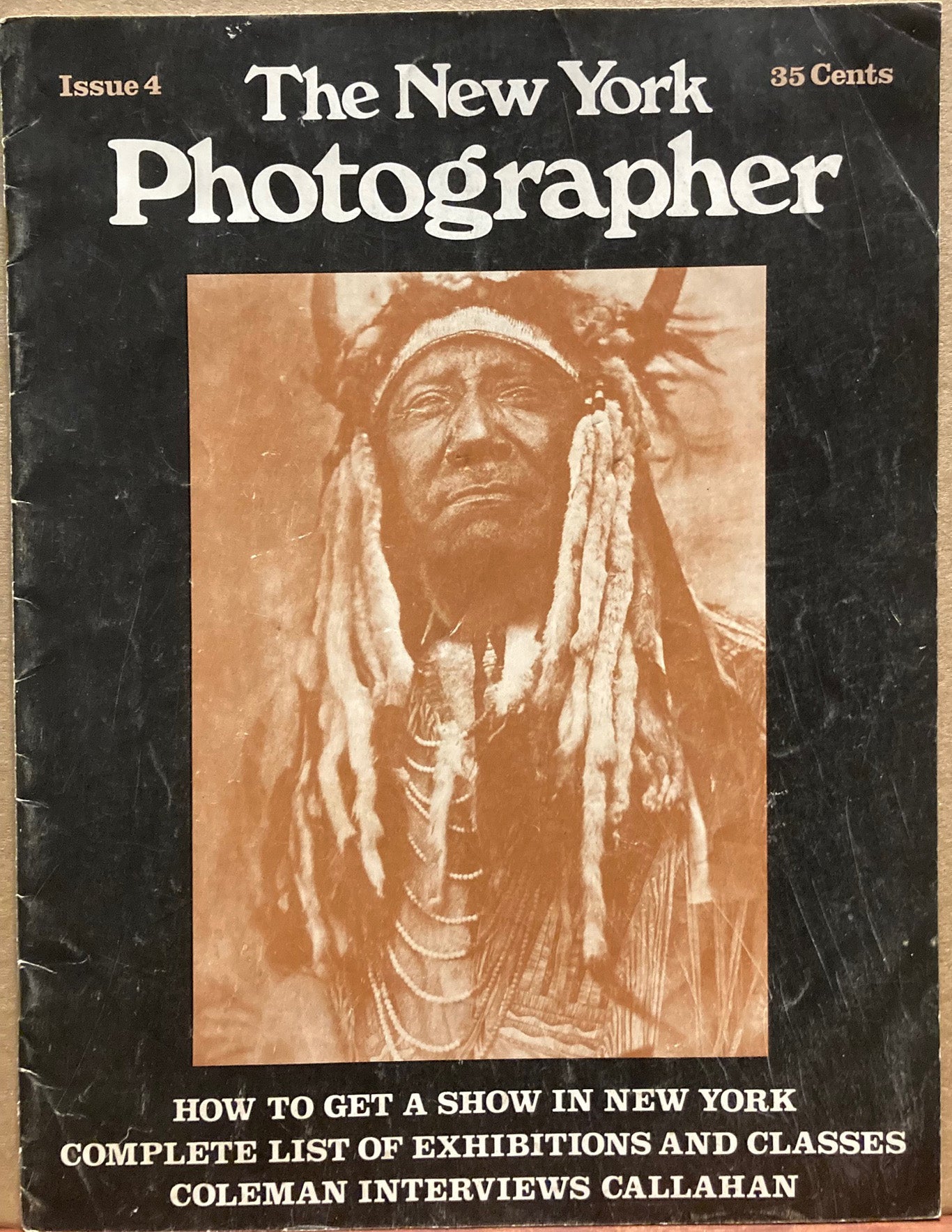
Callahan, Harry. "Harry Callahan: An Interview" by A.D. Coleman in New York Photographer, Issue 4, January 1972, pages 3-6.
Callahan, Harry. "Harry Callahan: An Interview" by A.D. Coleman in New York Photographer, Issue 4, January 1972, pages 3-6.
Impossible de charger la disponibilité du service de retrait
Callahan talked about himself, his work, other photographers, his Rhode Island School of Design faculty colleague Aaron Siskind, and teaching. Entire issue, 18 pages, also includes survey of galleries; calendars of exhibits, classes, and workshops; reviews of shows by Edward Curtis, Roman Vishniac, Brassai, etc. Cover photo by Edward Curtis. Scarce magazine in the early years of the emerging New York photography scene of the 1970s. Good with signs of use and small stain at bottom edges. Summary:
Published in January 1972 (Issue 4) by editor Carol Leand, New York Photographer is a short-lived independent photography magazine highlighting contemporary practitioners, gallery listings, and critical commentary. The issue’s primary feature is a substantial interview with Harry Callahan conducted by prominent photography critic A. D. Coleman.
In the interview, Callahan discusses his intuitive, non-intellectualized approach to image-making, his lack of formal art training, and his reliance on personal instinct rather than rigid art theory. He reflects on his career, touching upon his teaching philosophy alongside colleagues like Aaron Siskind at the Institute of Design and the Rhode Island School of Design (RISD), his experiments with color work and filmmaking, and the influence of early mentors such as László Moholy-Nagy and Walker Evans. The remainder of the issue includes a regional survey of art galleries, calendars for upcoming classes and exhibitions, and reviews of shows featuring Edward Curtis, Brassaï, and Roman Vishniac.
Harry Callahan (1912–1999) was an American photographer and educator who became one of the most influential figures in modern American photography. Self-taught initially, his path transformed after attending a 1941 workshop led by Ansel Adams, which inspired him to explore strict visual formalisms and the expressive potential of the camera. Recruited by László Moholy-Nagy in 1946 to teach at the Institute of Design in Chicago, and later heading the photography department at the Rhode Island School of Design, Callahan shaped generations of artists while maintaining a intensely personal creative practice. Known for his elegant experiments with high contrast, double exposures, light trails, and intimate portraits of his wife Eleanor and daughter Barbara, his work seamlessly bridged formal abstraction with deeply felt personal narrative, establishing him as a master of 20th-century American photography.
