Gary Saretzky Photo Books
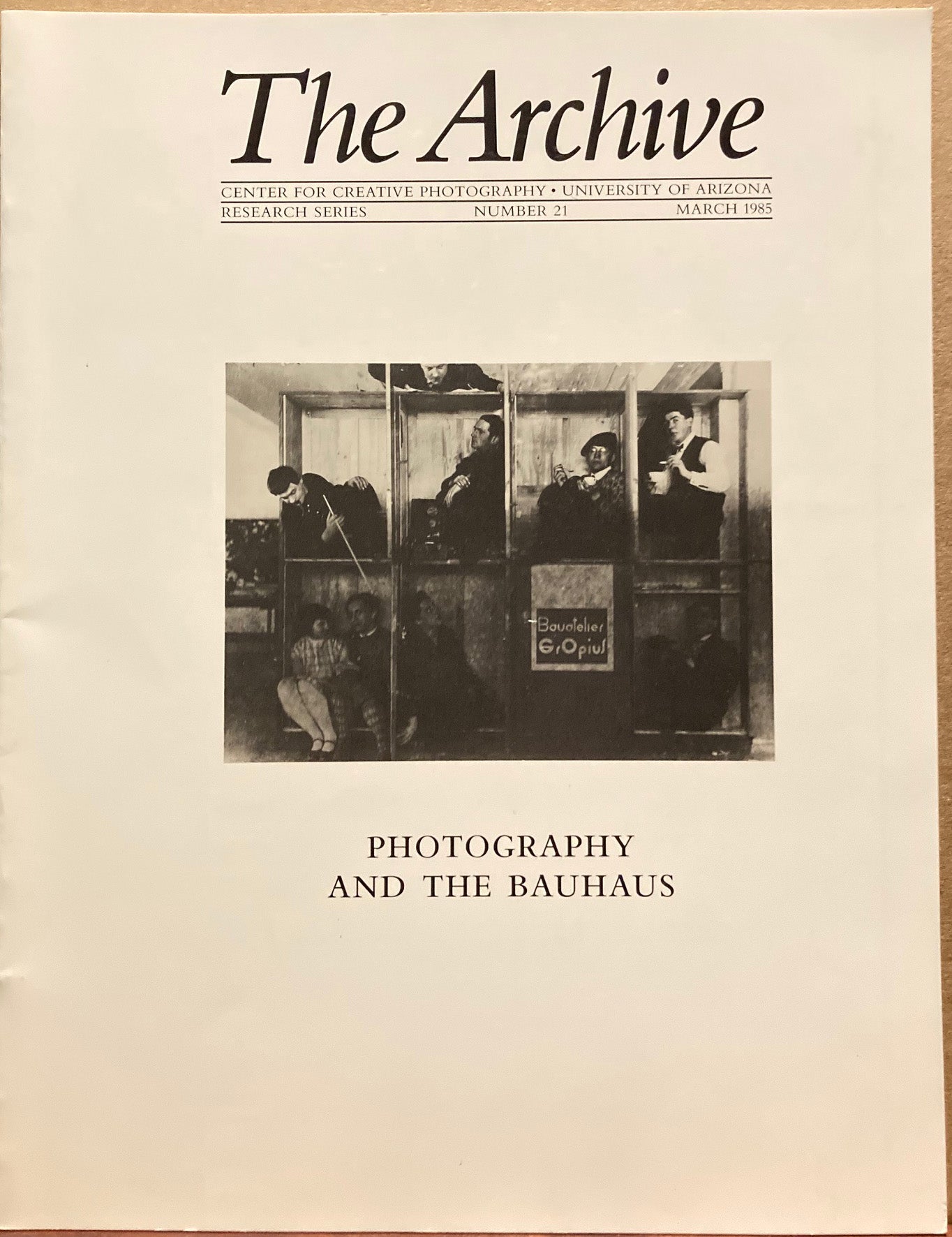
Bauhaus. Photography and the Bauhaus with essay by Suzanne E. Pastor.
Bauhaus. Photography and the Bauhaus with essay by Suzanne E. Pastor.
Impossible de charger la disponibilité du service de retrait
The Archive, Research Series, Number 21, March 1985. Center for Creative Photography, University of Arizona. 64 pages. Essay with illustrations by Suzanne E. Pastor. Bauhaus Portfolio with 27 plates. Chart with Bauhaus masters and workshops. Illustrations by Franz Roh, Umbo, Lucia Moholy, Lotte Beese, Joost Schmidt, Katt Both, Hannes Meyer, Hebert Bayer, T. Lux Feininger, Walter Peterhans, et al. As new in wraps, as issued. Summary:
In Photography and the Bauhaus, Suzanne E. Pastor explores how the Bauhaus—the influential German school of art, design, and architecture (1919–1933)—transformed photography from a mere recording tool into a revolutionary medium of modern expression.
The "New Vision" (Neues Sehen)
The central theme of the book and Pastor’s essay is the shift toward New Vision. This movement rejected traditional, painterly photography in favor of techniques that emphasized the camera’s unique mechanical properties.
Key techniques discussed include:
-
Extreme Perspectives: High-angle (bird’s-eye) and low-angle (worm’s-eye) shots to defamiliarize everyday objects.
-
Photograms: Camera-less images created by placing objects directly on light-sensitive paper, championed by László Moholy-Nagy.
-
Photomontage and Collage: Layering images to create complex social and political narratives.
-
Macro Photography: Intense close-ups that turn organic forms into abstract patterns.
Key Contributions of Suzanne E. Pastor's Essay
Pastor’s essay contextualizes the photography department within the larger Bauhaus curriculum. She highlights:
-
László Moholy-Nagy's Influence: His arrival in 1923 marked the turning point where photography became central to the school's philosophy of "Art and Technology: A New Unity."
-
Walter Peterhans: His later appointment in 1928 brought a focus on technical precision, still life, and the "poetics of objects."
-
Integration with Design: How photography was used not just as fine art, but as a vital component of typography, advertising, and architectural documentation.
Historical Legacy
The book illustrates that the Bauhaus did not just teach photography; it created a visual language for the 20th century. By breaking the rules of perspective and realism, the Bauhaus photographers paved the way for modern photojournalism, fashion photography, and graphic design.
