Gary Saretzky Photo Books
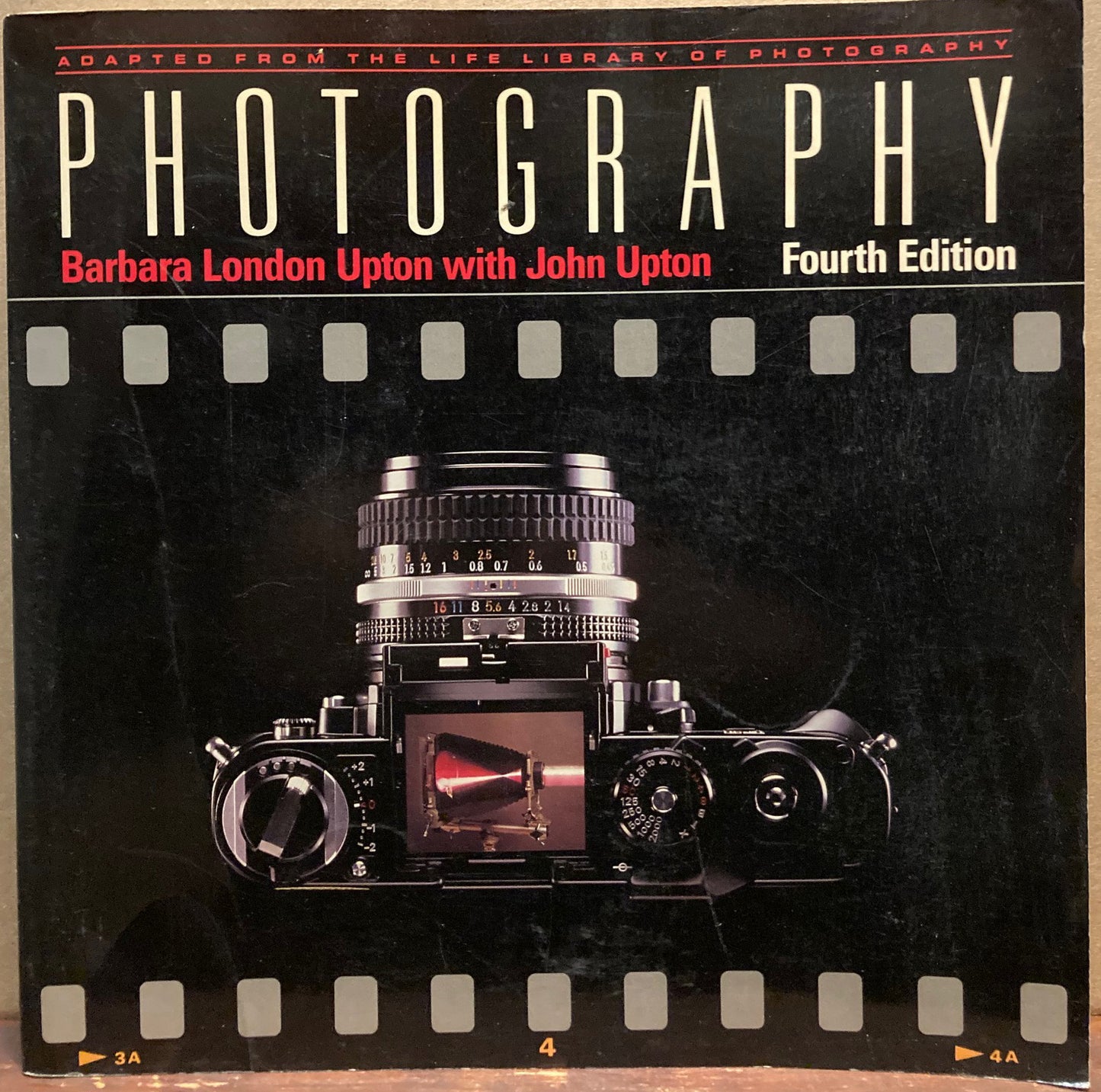
Upton, Barbara London with John Upton. Photography, Fourth edition by Barbara London Upton and John Upton.
Upton, Barbara London with John Upton. Photography, Fourth edition by Barbara London Upton and John Upton.
Impossible de charger la disponibilité du service de retrait
Scott, Foresman, 1989. [Textbook, covers camera, lens, light and film, exposure, negative development, printing, finishing & mounting, special techniques, color, lighting, view camera, zone system, "seeing," & history of photography. Also portfolio of fine images by Berenice Abbott, Frank Gohlke, Jan Groover, George Tice, Minor White, Duane Michals, Jim Goldberg, Louise Dahl-Wolfe, Sandi Fellman, Joel Sternfeld, Garry Winogrand, Karsh, Ernst Haas, Moholy-Nagy (in color), et al.] Wraps, near very good with some crimps on covers and slight wear at corners, 426 pages. Heavy book. Not to be confused with the 1989 reprints published by Pearson and HarperCollins. Summary:
Photography, Fourth Edition (1989), written by Barbara London Upton and John Upton (originally adapted from the foundational LIFE Library of Photography series), is widely considered the "bible" of introductory and advanced photographic education. Spanning over 400 pages, this textbook balances comprehensive, technical instructions with an exploration of visual literacy and art history.
Because the fourth edition was published in 1989, it stands as a standard summation of the analog and chemical film era right before the digital revolution fundamentally transformed the medium.
1. Camera Mechanics and Exposure Controls
The textbook begins with the fundamental mechanics of the camera, ensuring students understand how light is physically captured:
-
The Trinity of Exposure: It features meticulous visual breakdowns of how shutter speed (controlling motion blur vs. sharpness), aperture (controlling depth of field vs. flat focus), and ISO/film speed operate together to establish correct exposure.
-
Camera Formats: The authors compare various equipment configurations, detailing the operational differences between 35mm Single-Lens Reflex (SLR) cameras, twin-lens reflexes, medium format, and large-format view cameras.
2. Optics and Lens Dynamics
The book dedicates substantial space to the science of optics and how lens choice shapes spatial reality:
-
It analyzes the distinct characteristics of normal, wide-angle, telephoto, zoom, and macro lenses.
-
It explains the physics of perspective, lens aberration, and how different focal lengths compress or expand the perceived distance between the foreground and background of a frame.
3. Black-and-White Chemistry and Darkroom Processing
A core pillar of the fourth edition is its deep, step-by-step dive into traditional black-and-white laboratory work:
-
Film Development: It charts the exact chemical progression of developer, stop bath, and fixer required to transform exposed silver halide crystals into a stable negative.
-
The Zone System: The authors demystify Ansel Adams’ famous Zone System, teaching students how to plan exposure and development to preserve detail across ten distinct zones of tone, from pure black to maximum white.
-
Darkroom Printing: It covers advanced printing techniques, including how to use contrast filters, enlarge negatives, and selectively alter exposures across an image using dodging and burning.
4. Color Theory and Lighting
-
The Chemistry of Color: The text outlines how color film functions using multiple, light-sensitive emulsion layers (sensitive to blue, green, and red light) and explores common color processes like slide (chromogenic) and print film.
-
The Qualities of Light: Students are taught to identify and manipulate different lighting setups, breaking down the artistic and technical differences between harsh direct sunlight, soft diffused ambient light, and artificial studio flash units.
5. Visual Awareness and Composition
Moving beyond technical engineering, the book functions as a manual for visual communication:
-
It trains the photographer’s eye to critique how elements like lines, textures, shapes, backgrounds, and the geometry of the camera frame itself direct the viewer's eye.
-
It asks students to evaluate time and motion, demonstrating how a single frame can isolate a fraction of a second or blur time into a continuous flow.
6. Historical Survey
The volume closes with a sweeping, illustrated survey of photo history. It charts the medium's path from 19th-century experiments like the Daguerreotype and Calotype, through the socially conscious photojournalism of the mid-20th century, up to the avant-garde fine-art installations of the late 1980s.
Significance
The Fourth Edition of London and Upton’s Photography remains a gold standard in academic art history. By successfully breaking down complex mathematical and chemical concepts into clear, highly illustrated modules, the authors created a definitive manual that taught an entire generation of college students how to command the camera as a precise tool for both personal and artistic expression.