Gary Saretzky Photo Books
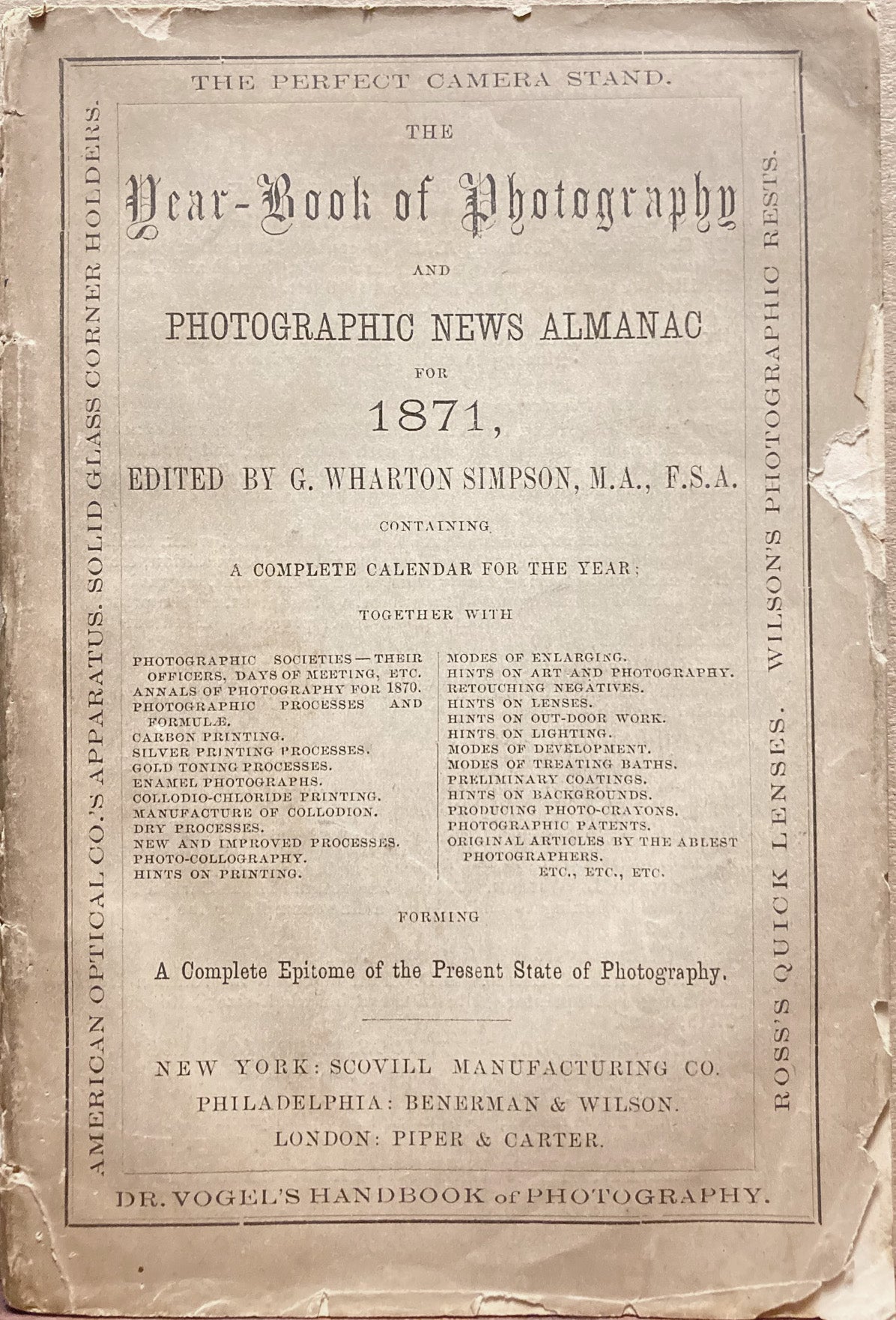
Annuals. The Year-Book of Photography and Photographic News Almanac for 1871.
Annuals. The Year-Book of Photography and Photographic News Almanac for 1871.
Impossible de charger la disponibilité du service de retrait
NY: Scovill; Philadelphia.: Benerman & Wilson; London: Piper & Carter. Edited by G. Wharton Simpson. First edition, not a reprint. Wraps, aqua color paper covers, pages show age toning, cover chipped, generally very good. 126 pages plus 36 pages of ads at back of book. From the library of photographer Sol Libsohn, one of the founders of the Photo League, although prior ownership not indicated in book. Contents include: Adam-Salomon, Art Photography in England; Francis Bedford, Hints on Landscape Photography; Jabez Hughes, Daguerreotypes; H.P. Robinson, A Hint from America; William England, Hints on Development; J.H.Dallmeyer, Optics; Valentine Blanchard, On Making Vignettes; J.W. Swan, Photolithography; H. Vogel, Management of Light; Walter Woodbury, Tissue Negatives; R.M. Gordon, Dry Plates; O.G. Rejlander, Photography and Art; J.R. Johnson, Autotype Process; Clement Rogers, Hints to Sitters and Visitors in the Studio; and many other articles. Housed in a stiff protective archival envelope with a polyester window. Scarce, especially in this condition. Summary:
The Year-Book of Photography and Photographic News Almanac for 1871, edited by G. Wharton Simpson, serves as a comprehensive technical and industrial "time capsule" of the photographic medium during the mid-Victorian era. Published at a time when photography was a complex chemical craft, it provided practitioners with the latest advancements, formulas, and professional standards.
Technical Focus: The Wet-Plate Era
The 1871 edition is dominated by the Collodion process. Because photographers still had to sensitize and develop their plates immediately, the book is filled with "hints and helps" for maintaining the delicate chemical balance of silver baths and developers. Key technical areas include:
-
The Search for Dry Plates: While the wet-plate process was standard, the almanac documents the frantic experimentation with "dry" processes (like the Coffee or Tea processes) to eliminate the need for a portable darkroom in the field.
-
Printing Innovations: It covers advancements in Albuminized paper and early mentions of the Carbon process, which offered greater permanence compared to traditional silver prints.
Professional & Artistic Trends
Beyond the chemistry, the book addresses the business and aesthetics of the 19th-century studio:
-
Studio Management: Detailed advice on lighting, posing, and the construction of glass houses (studios) to maximize the use of natural light.
-
The Franco-Prussian War: Reflecting the year of its publication, the text includes fascinating accounts of micro-photography used for "pigeon posts" to send messages during the Siege of Paris.
-
Retouching: A controversial subject at the time, the almanac provides guidance on how to subtly "improve" negatives without destroying the "truth" of the image.
Structure and Content
The almanac was designed for daily use in the darkroom and office:
-
The Calendar: Includes astronomical data and seasonal advice for photographers.
-
Standard Formulas: A "recipe book" for developers, toners, and varnishes used by the leading photographers of the day.
-
Directory of Societies: A listing of the growing number of photographic clubs and societies across the UK and Europe.
Historical Significance
The 1871 Year-Book is a primary resource for historians of technology. It illustrates the final decade of dominance for the wet-plate process before the revolution of the gelatin dry plate. It captures a professional community that was half-scientist and half-artist, struggling to standardize a medium that was rapidly becoming the world's most important visual record.