Gary Saretzky Photo Books
Seymour, David. "Chim's Way" by Inge Bondi in Camera 35, January 1970.
Seymour, David. "Chim's Way" by Inge Bondi in Camera 35, January 1970.
Impossible de charger la disponibilité du service de retrait
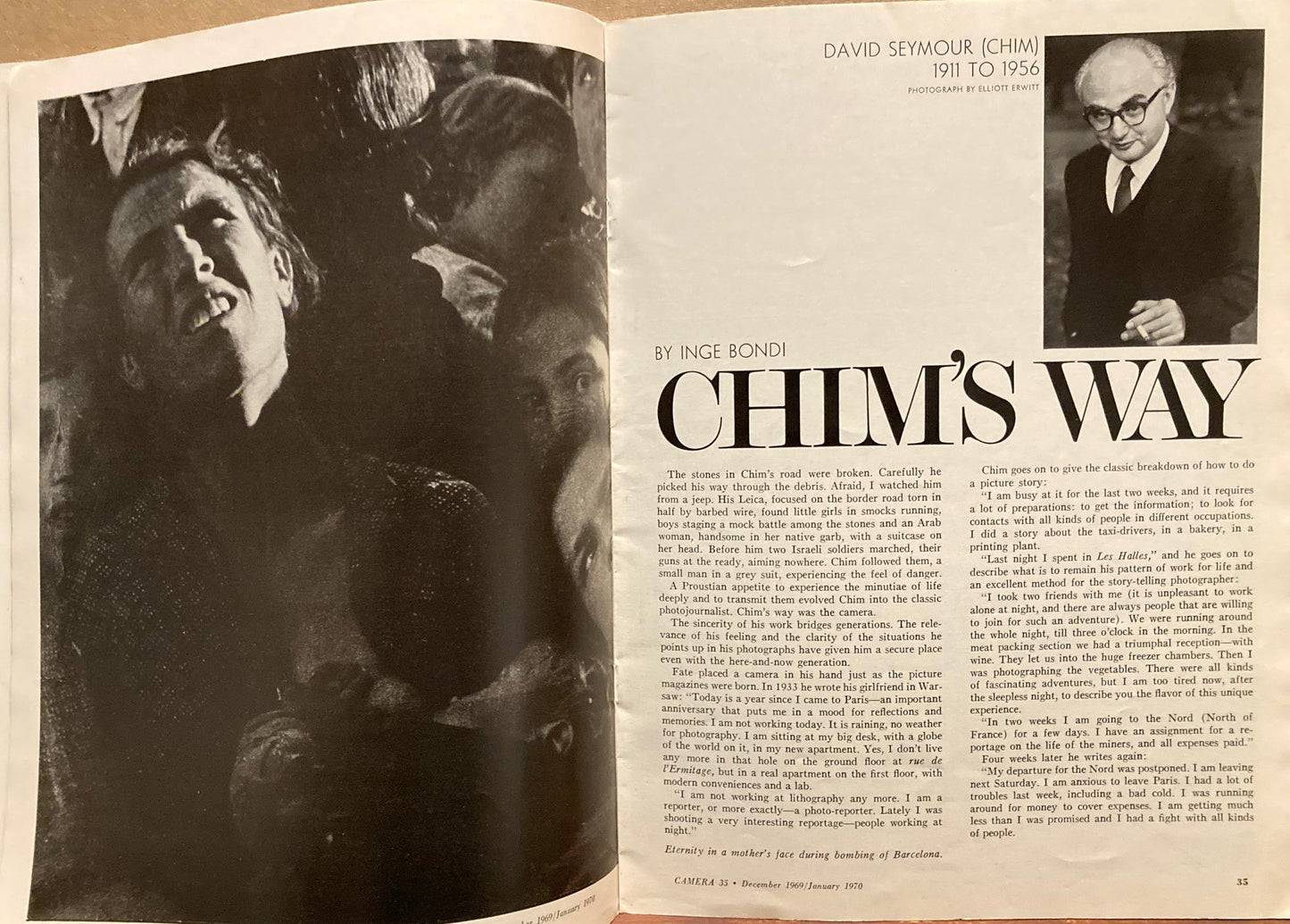
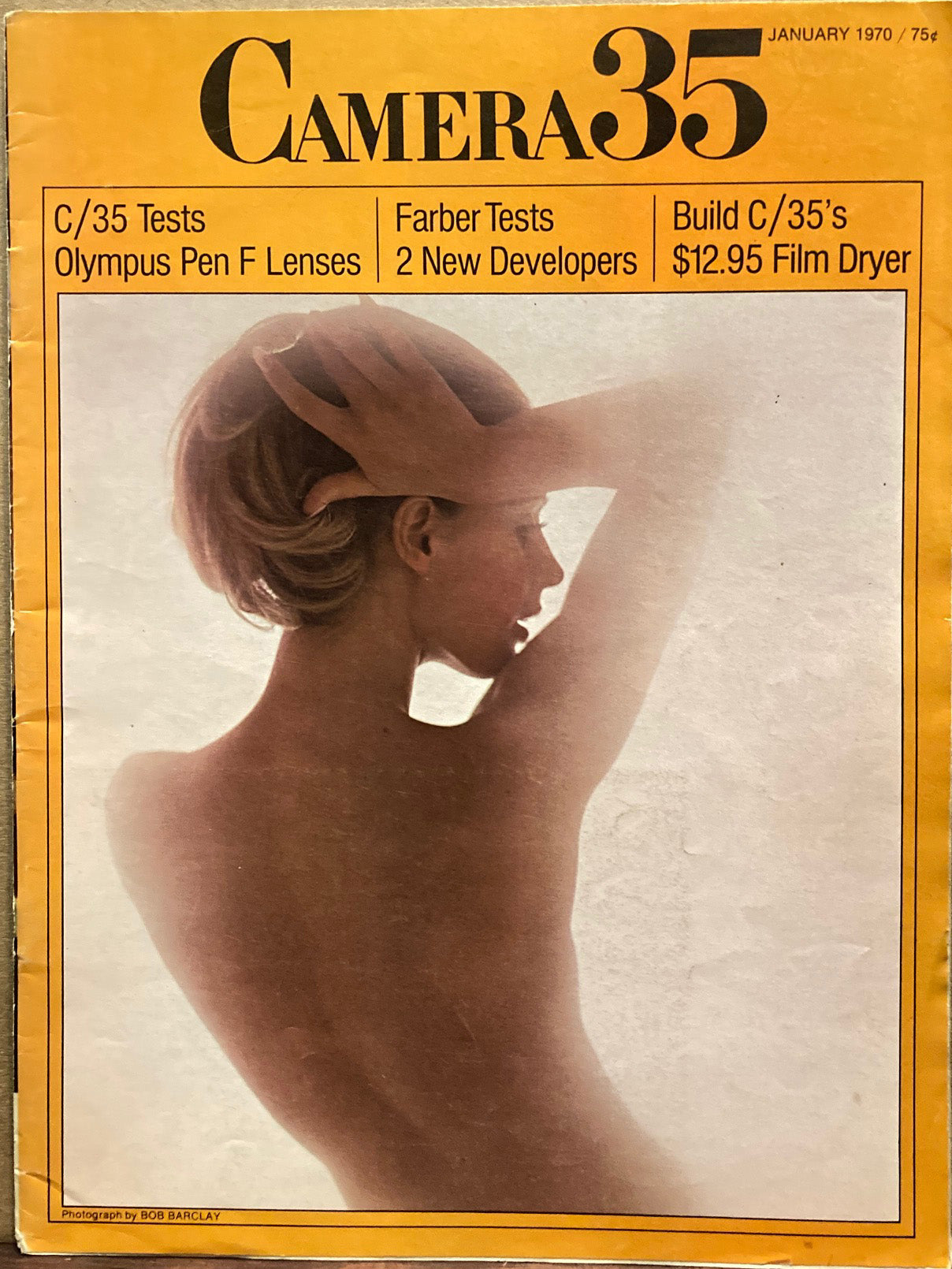
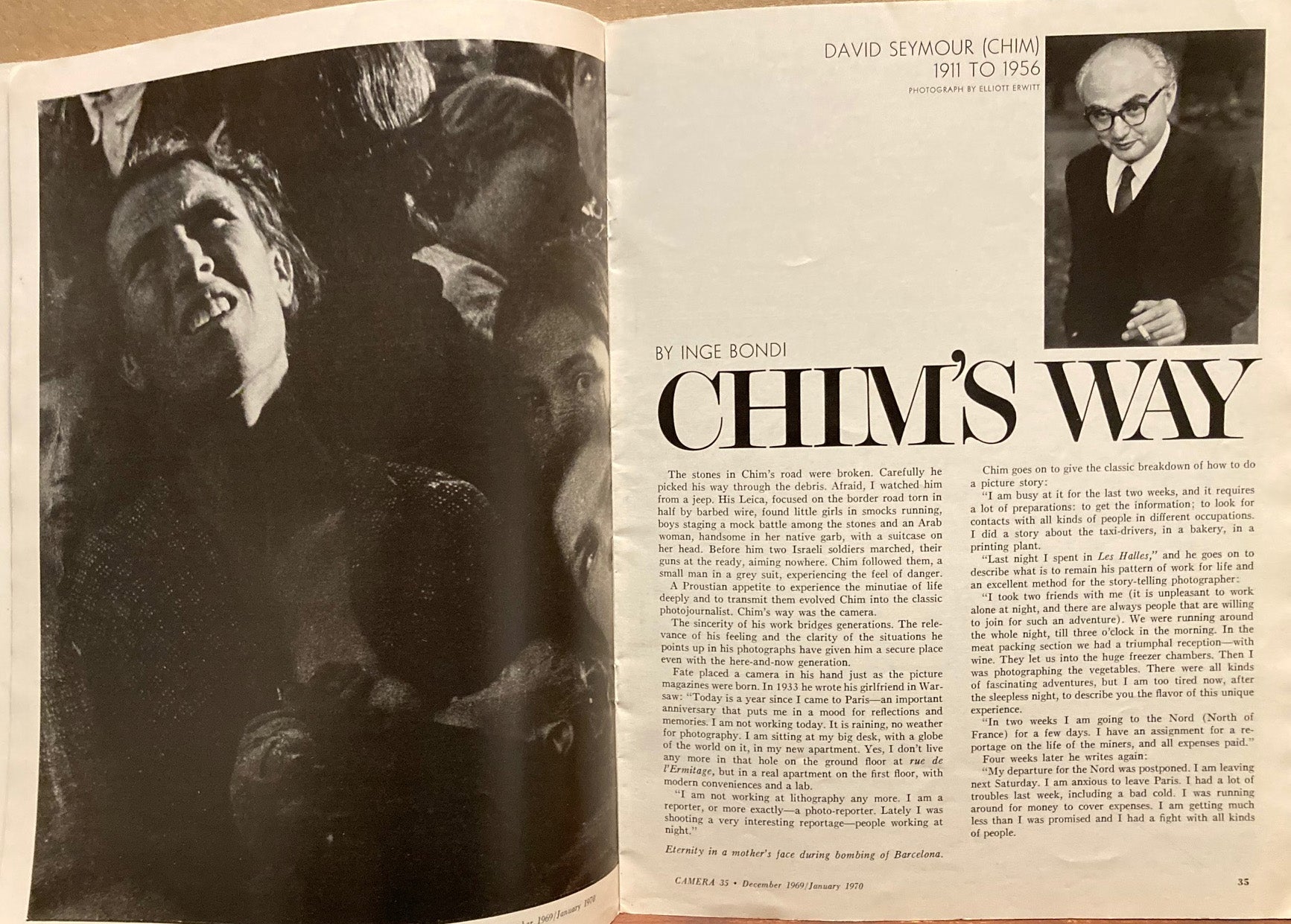
Entire issue, 74 pages, in very good condition evidencing normal use. Chim article and portfolio, pp. 34-42, 58, 60, 62. Chim’s sister, Mrs. Eileen Schneiderman, provided early letters quoted in this article. Other articles include "Back to Gum Prints" by Peter Leibert re gum bichromate.
David Seymour (1911–1956), widely known by his pseudonym "Chim," was a pioneering Polish-born photojournalist, humanitarian photographer, and co-founder of the legendary Magnum Photos agency alongside Henri Cartier-Bresson and Robert Capa. Born Dawid Szymin in Warsaw, Seymour studied printing and graphic arts in Leipzig and philosophy in Paris before embarking on a distinguished photojournalistic career in the 1930s, capturing the rise of the Popular Front in France and documenting the Spanish Civil War. During World War II, he served as a photo reconnaissance interpreter in the United States Army before returning to Europe to undertake his most celebrated assignment: a poignant, deeply empathetic 1948 photographic essay for UNESCO titled Children of Europe, which documented the harrowing psychological and physical toll of war on displaced orphans. Renowned for his compassionate eye, profound humanism, and ability to capture quiet, vulnerable moments amidst geopolitical crisis, Seymour continued his fearless reporting until November 1956, when he was tragically killed by Egyptian machine-gun fire while covering the Suez Crisis just days before the armistice.
The January 1970 issue of Camera 35 features "Chim's Way," a seminal biographical essay and portfolio curated by photography scholar and critic Inge Bondi. The feature serves as an intimate, deeply researched retrospective on the life, ethics, and methodology of the legendary Polish-born photojournalist David Seymour, known professionally as "Chim." Written over a decade after Chim's tragic death during the 1956 Suez Crisis, the piece relies heavily on exclusive primary source materials—including early personal letters provided by Chim's sister, Eileen Schneiderman—to construct a definitive profile of the Magnum Photos co-founder.
Key Elements of the Feature
-
The Psychology of "Chim’s Way": Bondi’s article explores the unique intellectual and emotional mindset behind Chim's photography. Unlike the high-drama, kinetic approach of his contemporary and close friend Robert Capa, "Chim’s way" was defined by a quiet, unobtrusive presence, immense historical understanding, and a profound empathy that allowed him to connect deeply with his subjects.
-
The Vulnerability of Children: A central focus of the essay and accompanying portfolio is Chim's landmark work for UNICEF documenting the displaced youth of post-WWII Europe. Bondi analyzes how Chim approached traumatized children without artifice or aggressive studio lighting, capturing them with a level of purity and respect that made his images speak simply and directly to the viewer.
-
Unpublished Texts and Correspondence: The feature holds significant historical value due to its inclusion of Chim's early letters. These writings illuminate his personal transitions from studying physics in Leipzig to entering the Parisian photojournalism scene in the 1930s, offering a rare glimpse into his private thoughts on war, politics, and the responsibilities of a visual witness.
-
A Broad Professional Blueprint: Bondi maps out how Chim’s multilingualism and diplomatic nature made him equally adept at navigating complex geopolitical situations, interviewing heads of state, and organizing Magnum Photos behind the scenes, cementing his legacy as a deeply intellectual humanist.
Summary
Inge Bondi’s "Chim's Way" in the January 1970 issue of Camera 35 is a crucial piece of photographic scholarship. By blending rare personal primary sources with a comprehensive visual portfolio, the feature successfully demystifies David Seymour's quiet genius, framing him not just as a standard wartime photojournalist, but as an irreplaceable, compassionate pioneer of modern documentary art.