Gary Saretzky Photo Books
Photography Between the Wars: Selections from the Ford Motor Company Collection by Maria Morris Hambourg.
Photography Between the Wars: Selections from the Ford Motor Company Collection by Maria Morris Hambourg.
Impossible de charger la disponibilité du service de retrait
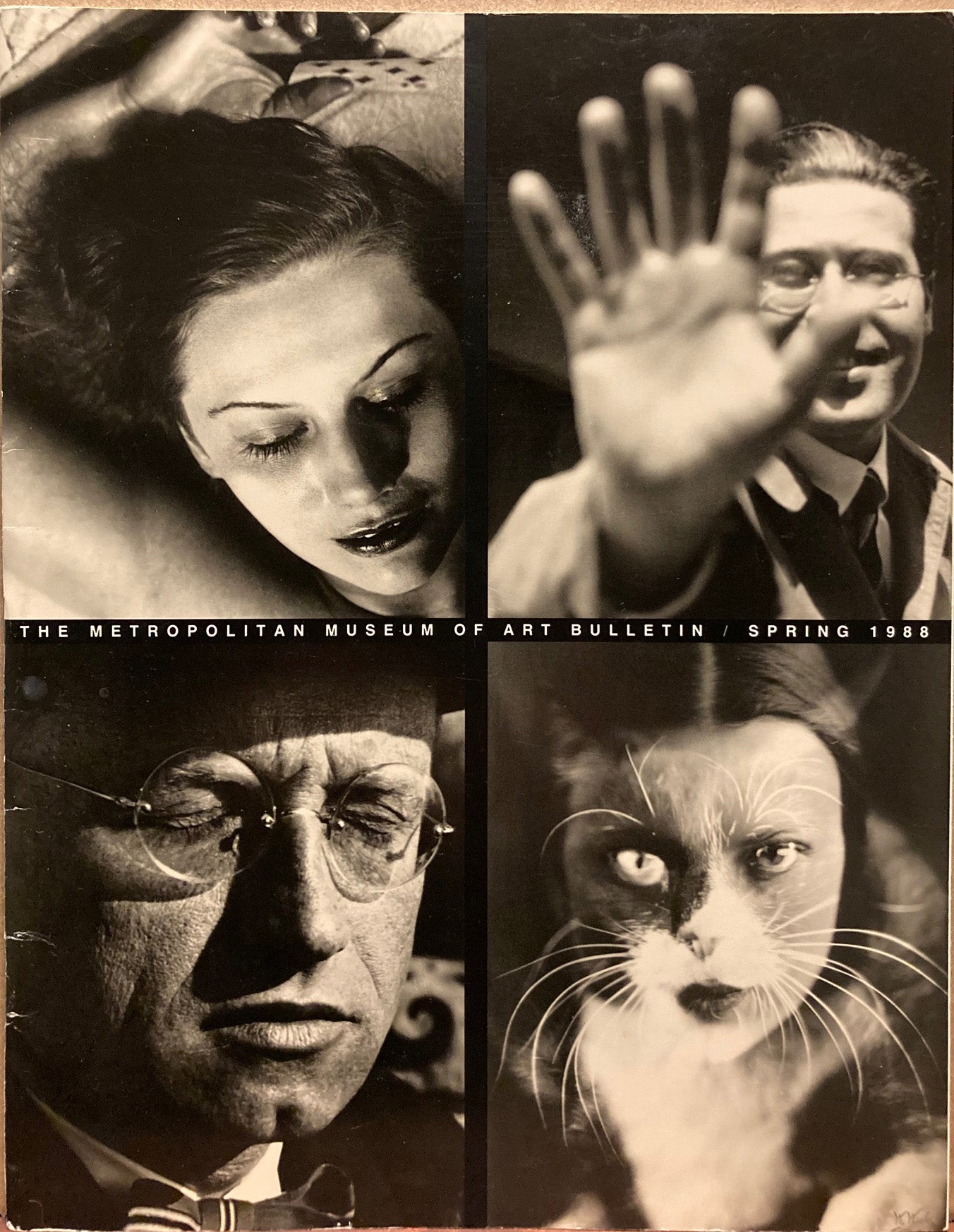
Metropolitan Museum of Art Bulletin, 45:4, Spring 1988. Photographers: Man Ray; Raoul Hausmann; Paul Strand; Morton Schamberg; Lewis Hine; Paul Outerbridge; Erich Salomon; Martin Munkacsi; Charles Sheeler; Alfred Stieglitz; Alexander Rodchenko; Albert Renger-Patzsch; Edward Weston; August Sander; Maurice Tabard; Umbo; Laszlo Moholy-Nagy; Eugene Atget; Clarence John Laughlin; El Lissitzky; Hans Bellmer; James Doolittle; Lisette Model; Bill Brandtl; Brassai; Berenice Abbott; Andre Kertesz; Henri Cartier-Bresson; Helen Levitt; and Walker Evans. From the collection of the late photographer Louis H. Draper, although unmarked. Illustrated wraps, 56 pages. VG+ with a few crimps. Summary:
Photography Between the Wars: Selections from the Ford Motor Company Collection (published by The Metropolitan Museum of Art in 1988) is a specialized 56-page museum publication written by eminent photography curator Maria Morris Hambourg. Issued as the Spring 1988 volume of The Metropolitan Museum of Art Bulletin, this monograph documents a transformative corporate acquisition of avant-garde European and American photography from the 1920s and 1930s, offering a critical look at the rise of international modernism.
Core Content & Conceptual Framework
1. The Interwar Visual Revolution
The text traces the radical aesthetic shift that occurred in the two decades between World War I and World War II. The narrative outlines how a new generation of photographers decisively turned away from the soft-focus, painterly traditions of turn-of-the-century Pictorialism. The historical presentation describes how these artists embraced the camera as an intrinsically modern machine, perfectly adapted to record the rapid industrialization, architectural geometry, and psychological fractures of the era.
2. Integration with Avant-Garde Movements
The publication focuses on how photography became central to the most progressive artistic movements of the interwar period. The monograph provides a framework for understanding how image-makers adopted and fueled diverse conceptual philosophies:
-
European Modernism and the New Vision: Works that utilized experimental perspectives, photograms, and structural abstractions to challenge traditional human perception.
-
Dadaism, Surrealism, and Futurism: Provocative studio manipulations, collage techniques, and psychological compositions from pioneering international masters.
-
Straight Photography and Urban Realism: Razor-sharp documentary frames and street portraiture capturing daily realities by defining figures of early 20th-century realism.
3. Institutional Impact and the Ford Collection
The essays frame the Ford Motor Company Collection as a monumental addition to the Metropolitan Museum’s permanent holdings, which had previously been anchored primarily by the classic Alfred Stieglitz collection. The technical commentary details the rarity and material value of these original, vintage prints, noting that many modern painting and graphic design techniques were directly borrowed from these early photographic experiments. The volume balances historical contextualization with high-quality, full-page reproductions, analyzing how individual masterworks laid the foundation for modern visual culture.
Photography Between the Wars stands as a vital curatorial record documenting the institutional integration of radical interwar modernism into a major American museum. By mapping the shared visual lexicon of European and American photographers, Hambourg's scholarship validates the medium as the primary artistic vehicle of the early 20th century and maps out the origins of our contemporary visual identity.
