Gary Saretzky Photo Books
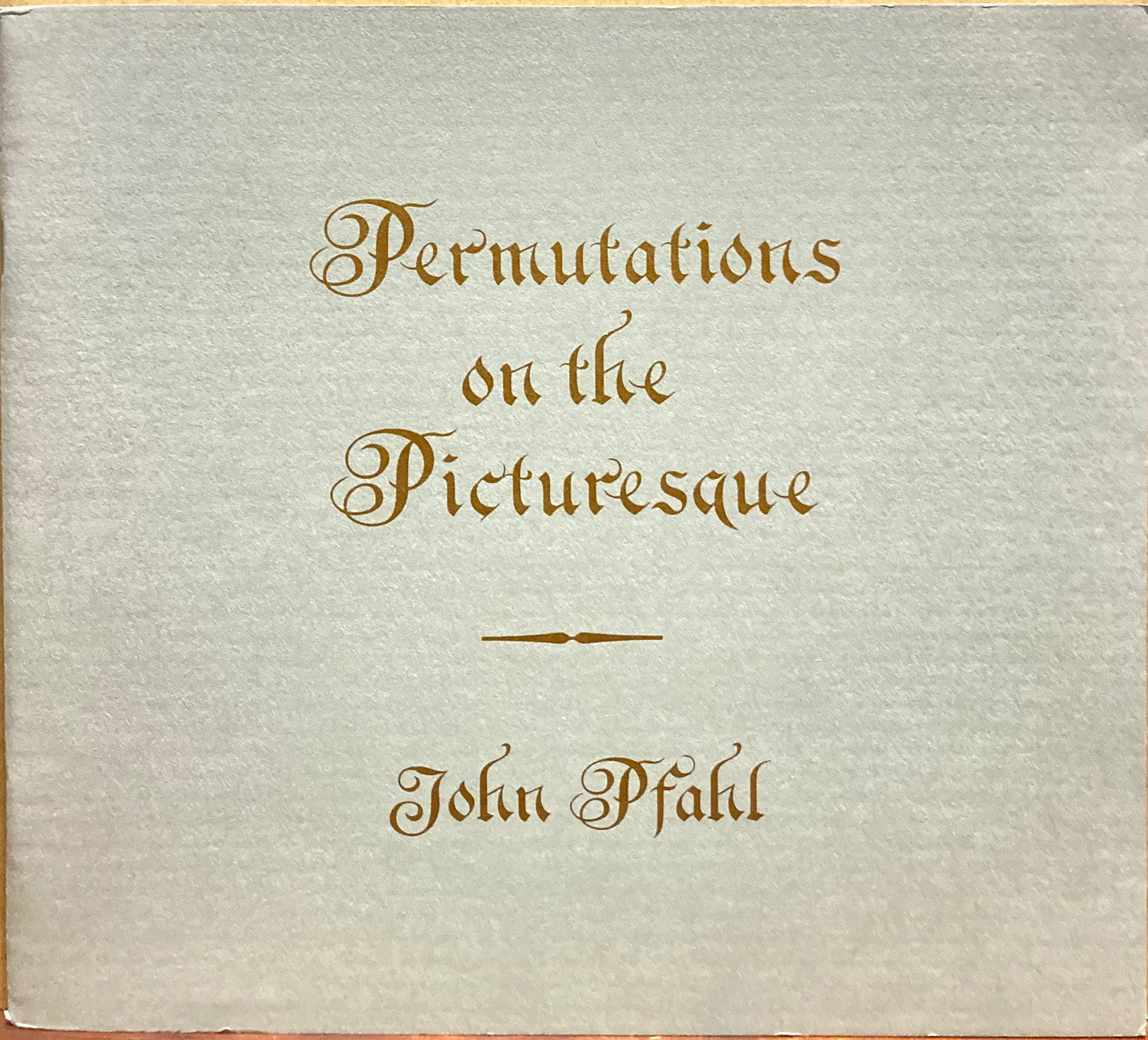
Pfahl, John. Permutations on the Picturesque by John Pfahl.
Pfahl, John. Permutations on the Picturesque by John Pfahl.
Impossible de charger la disponibilité du service de retrait
No. 49, Robert B. Menschel Photography Gallery, Syracuse University, 1997. Exhibit catalog of 20 computer-enhanced Iris prints of images taken in England, Wales, and Italy. Summary:
Permutations on the Picturesque (published by Light Work / The Robert B. Menschel Photography Gallery in 1997) is a specialized 44-page exhibition catalog documenting a conceptually driven landscape project by pioneering American photographer John Pfahl. Issued as publication number 49 in the Menschel Gallery series for an exhibition running from August 25 to October 19, 1997, at Syracuse University, the monograph includes an essay by Gary Hesse alongside an introductory artist statement. It explores the intersections of classical aesthetics and early digital manipulation.
Core Content & Conceptual Framework
1. Reinterpreting 18th-Century Landscape Traditions
The project deliberately engages with the historical concept of the "Picturesque"—an aesthetic ideal popularized in late 18th-century Britain that sought a middle ground between the serene Sublime and the awe-inspiring Beautiful. The formal design tracks how Pfahl traveled to historic vistas across England, Wales, and Italy, utilizing specific 18th-century tour guide instructions to determine the exact subject matter, ideal framing, and optimal point of view for each location. By retracing the physical steps of classical painters, the work frames contemporary photography as a continuation of long-standing European landscape traditions.
2. Digital Hybridity and Material Illusion
The defining technical characteristic of the 19 color plates is their complex, multi-layered production process. The technical workflow shows how, after capturing the real-world landscapes on analog film, Pfahl scanned the negatives into a computer and digitally manipulated the color balances and textures. The resulting Iris prints purposefully emulate the soft, layered washes of a Romantic-era watercolor drawing rather than a traditional photographic print. This digital translation challenges the camera's historical role as a mechanical truth-teller, shifting the final image into the realm of painterly fabrication.
3. Exposing the Technological Framework
To ensure the work was not misread as simple pastiche, Pfahl embedded an intentional digital signature within each composition. Running the entire length of every landscape is a distinct horizontal row of heavily enlarged, blocky pixels. This sharp geometric line slices through the otherwise soft, pastoral scenery, systematically disrupting the pictorial illusion. By drawing direct attention to the computer-assisted construction of the file, the visual strategy reminds the viewer of the modern digital tools mediating their experience of nature.
Copies available: Wraps, as issued, near fine. Same, like new,
