Gary Saretzky Photo Books
History of Photography. The Camera Viewed. Writings on Twentieth-Century Photography.
History of Photography. The Camera Viewed. Writings on Twentieth-Century Photography.
Impossible de charger la disponibilité du service de retrait
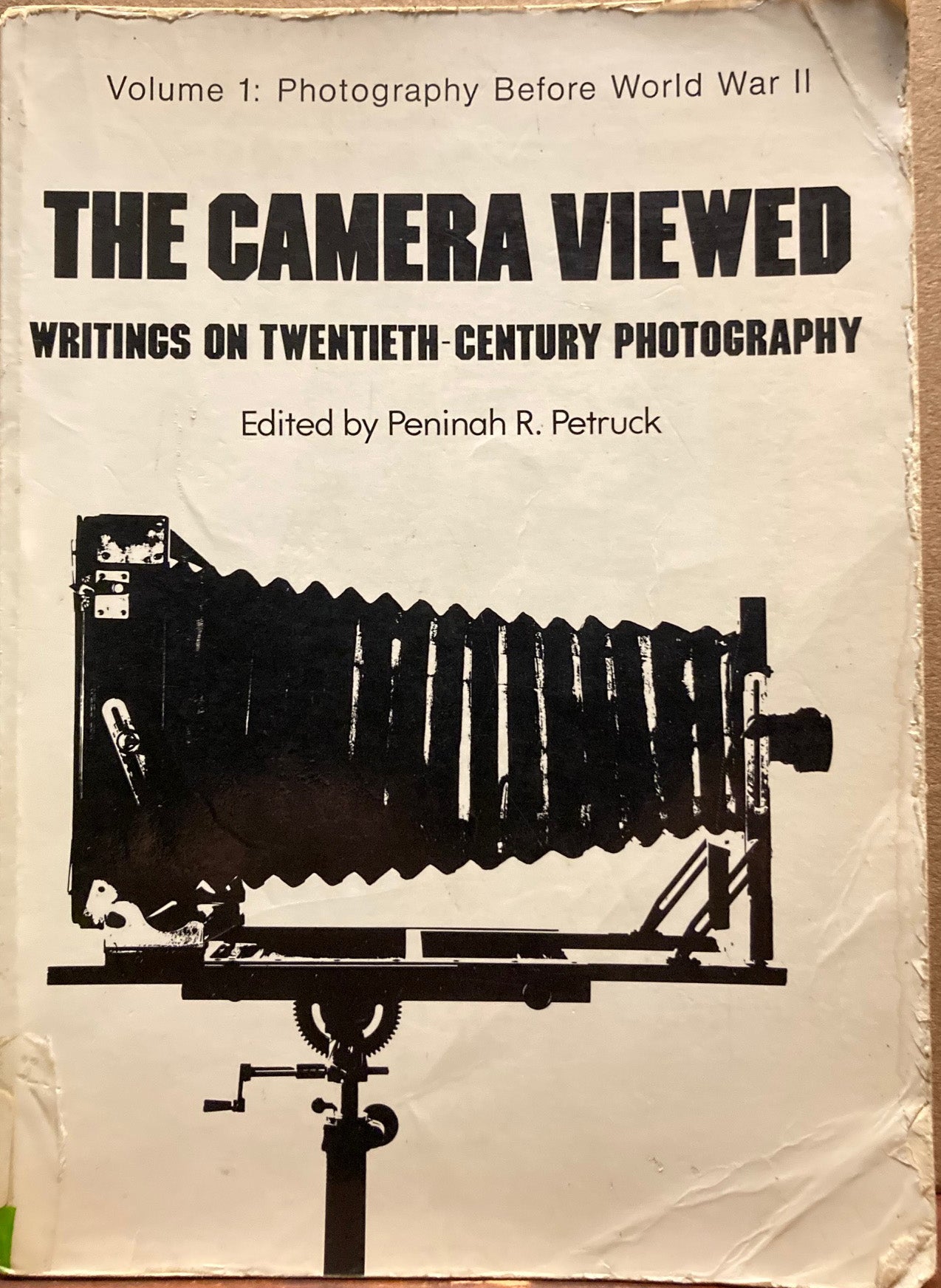
Volume 1: Photography Before World War II. Edited by Peninah R. Petruck. E.P. Dutton, 1979. 1st printing in wraps. Includes texts by Jonathan Green re Camera Work; Alfred Stieglitz, "Looking for Mr. Stieglitz," from Twice a Year; Georgia O'Keeffe, "Stieglitz" (1949); Carl Sandburg, "Steichen the Photographer" (1929); Marius de Zayas, "Photography" (1913); Paul Strand, "Painting and Photography" (1963); Calvin Tomkins re Strand; Edward Weston, "Photographic Art" (1942); Andy Grundberg re Edward Weston; Charles Millard re Charles Sheeler; interview with Walker Evans (1971); Roy Stryker re the FSA; Moholy-Nagy, "New Instrument of Vision" (1932); Caroline Fawkes re Moholy-Nagy; John Fraser re Atget; John Fuller re Atget and Man Ray; Man Ray, "Photography Is Not Art" (1943); Joe Deal interview with Horst (1975) re fashion photography; Walter Benjamin, "The Work of Art in the Age of Mechanical Reproduction" (excerpt, 1936). With illustrations by Gertrude Kasebier, Clarence White, Edward Steichen, Russell Lee, and others including some of the writers. Ex-library copy with wear to extremities and creases on covers, still excellent for reference. Summary:
The Camera Viewed: Writings on Twentieth-Century Photography, Volume 1: Photography Before World War II(published by E.P. Dutton in 1979) is a foundational 262-page anthology edited by art historian Peninah R. Petruck. The volume compiles essential essays, manifestos, and critical reviews penned by the photographers, critics, and theorists who actively shaped the trajectory of Western fine-art photography from the turn of the 20th century up to 1939.
Core Content & Critical Framework
1. The Fight for Photographic Autonomy
The early sections of the anthology focus on the intense debates surrounding photography's status as a legitimate fine art. The selected texts document the transition from Pictorialism—where photographers manipulated prints to look like charcoal drawings or etchings—to the philosophy of "Straight Photography." Through seminal writings by figures such as Alfred Stieglitz, Paul Strand, and Edward Weston, the book traces how early 20th-century artists learned to celebrate the camera's unique optical clarity, sharp focus, and geometric precision rather than masking its mechanical nature.
2. European Avant-Garde and Structural Experimentation
The middle chapters shift toward Europe between the wars, capturing a period of radical experimentation where photography became a central tool for socio-political and artistic revolution. The compilation features crucial manifestos and theoretical texts from major European movements, including:
-
The Bauhaus and New Vision: László Moholy-Nagy's writings on utilizing photograms, extreme camera angles, and light manipulation to expand human perception beyond traditional boundaries.
-
Dadaism and Surrealism: Man Ray and Max Ernst discussing how darkroom solarization, double exposures, and photomontage could tap into the subconscious mind and disrupt conventional reality.
-
Soviet Constructivism: Aleksandr Rodchenko's aggressive defense of the camera as an industrial tool meant to document modern labor and structural dynamism from non-traditional perspectives.
-
3. Documentary Realism and Social Witness
The final portion of the volume examines the rise of documentary photography during the social and economic upheavals of the 1930s. The anthology includes firsthand reflections from American photographers working under the Farm Security Administration (FSA), such as Dorothea Lange and Walker Evans, alongside European pioneers of candid street photojournalism like Henri Cartier-Bresson. These essays explore the ethical and aesthetic challenges of using the camera as an instrument for social change, balancing raw narrative truth with precise formal composition.
The Camera Viewed stands as an indispensable primary-source reader for students of visual culture and photographic history. By collecting scattered manifestos, exhibition reviews, and private journals into a single cohesive volume, Petruck provides a comprehensive intellectual map of how early 20th-century photography evolved from a contested hobby into the defining visual language of modern life.
