Gary Saretzky Photo Books
Palfi, Marion. Marion Palfi Archive.
Palfi, Marion. Marion Palfi Archive.
Impossible de charger la disponibilité du service de retrait
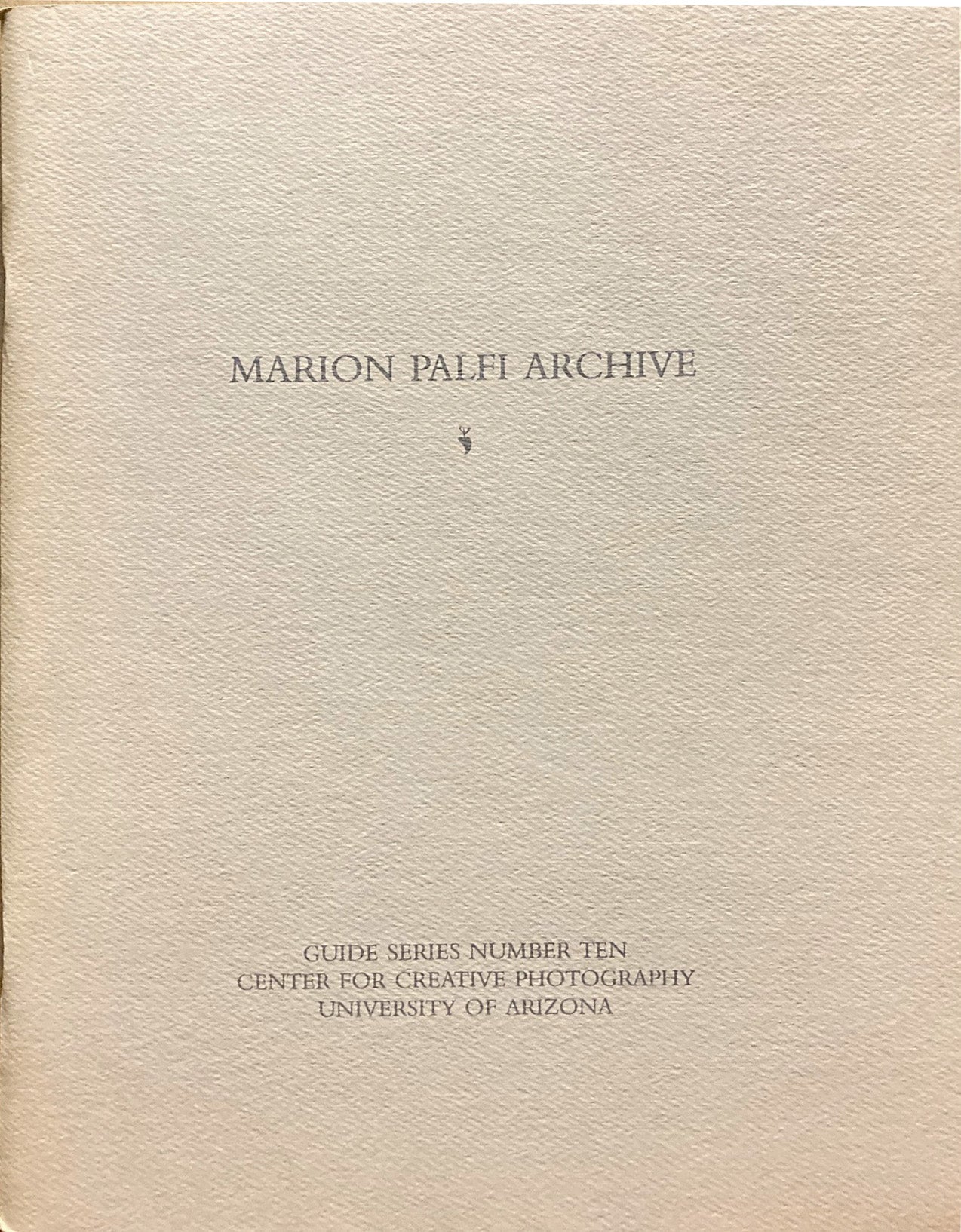
Guide Series Number 10. Center for Creative Photography, University of Arizona, 1978. Compiled by Robert Sorgnefrei and David Peters. Wraps, 78 pages, with biography by Sorgenfrei, bibliography, lists of archival materials, index to selected correspondence, numerous thumbnail photographs, etc. Fine with trace of fading along spine.
Marion Palfi (1907–1978) was a German-born American social-documentary photographer and self-described "social-research photographer" known for her powerful visual projects addressing systemic inequality in the United States. Born in Berlin, Palfi worked as an actress, dancer, and commercial portrait photographer before establishing her own studio in 1934. Fleeing the Nazi regime, she moved to Amsterdam in 1936 and emigrated to the United States in 1940. In America, she associated with the New York Photo League and dedicated her camera to illuminating civil rights issues, poverty, and social injustice. Supported by a Rosenwald Fellowship (1946), a Guggenheim Fellowship (1967), and a National Endowment for the Arts grant (1974), she produced influential photo essays and monographs—including There Is No More Time: An American Tragedy (1949), focused on Jim Crow laws and segregation, and Suffer Little Children (1952), addressing child neglect and juvenile delinquency. Her work was featured in Edward Steichen’s landmark 1955 exhibition The Family of Man at the Museum of Modern Art, and her extensive archive is now preserved at the Center for Creative Photography at the University of Arizona.
Marion Palfi: The Archive, Research Series, Number 19 (published by the University of Arizona & Center for Creative Photography in September 1983) is a specialized 39-page institutional monograph dedicated to the life and legacy of German-born social documentary photographer Marion Palfi. Edited and issued as part of the Center's ongoing research series, the softcover publication serves as a critical overview of Palfi's extensive archival holdings—the largest repository of her work in existence—which includes over 1,100 fine prints, scrapbooks, and correspondence.
Core Content & Biographical Survey
1. The Visual Portfolio of Social Injustice
The center of the publication features a dedicated plate portfolio showcasing Palfi's self-described "social research" photography. Rejecting lucrative commercial careers and popular aesthetic conventions, Palfi spent decades documenting the stark underbelly of the American Dream. The printed selection highlights her raw, un-editorialized imagery addressing systemic American inequities, including:
-
Racism and Segregation: Crucial mid-century documentation from her foundational projects, alongside stark studies of systemic poverty in the shadow of the nation's capital.
-
Marginalized Communities: Empathetic, research-driven portraits tracking the harsh realities of Native American relocation, elder housing neglect, juvenile delinquency, and the psychological weight of child abuse.
2. Biographical and Critical Framework
The publication is anchored by an extensive biographical and critical essay by art historian Elizabeth Lindquist-Cock. The text charts Palfi’s trajectory from her privileged youth as a model and dancer in Berlin, to opening a portrait studio in Amsterdam, to her 1940 emigration to New York. The analytical narrative explores Palfi’s unique working methodology—conducting exhaustive academic research before ever lifting her folding camera—and analyzes her prominent mid-century circle of colleagues, which included Langston Hughes, Eleanor Roosevelt, and John Collier, Sr.
3. Editorial Additions and Institutional Context
In addition to the primary focus on Palfi, the research booklet functions as a dual-facing scholarly ledger for the Center for Creative Photography. The volume includes a brief supplementary essay profiling the contemporary work of celebrated Mexican photographer Graciela Iturbide, paired with two of her black-and-white prints. The structural design indexes Palfi’s extensive written records, draft book maquettes, and notebooks, demonstrating how her work served as an instrument for visual sociology and direct political revolution.
Released five years after her death, The Archive, Number 19 stands as an essential scholarly recovery project that rescued Marion Palfi's pioneering post-war documentary work from relative obscurity. By pairing her uncompromising images with rigorous biographical text, the publication cements her status alongside the heavyweights of the Photo League and the Farm Security Administration as an indispensable witness to American civil rights struggles.
