Gary Saretzky Photo Books
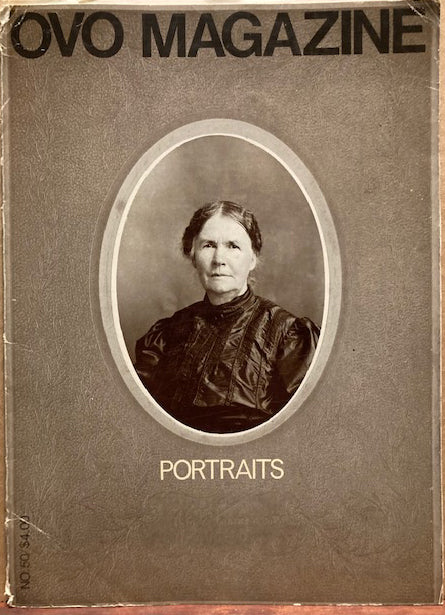
Ovo Magazine. Issue 50, Portraits, November 1983.
Ovo Magazine. Issue 50, Portraits, November 1983.
Impossible de charger la disponibilité du service de retrait
This beautiful large format Canadian publication features work by Louise Abbott, Claire Beaugrand-Champagne, Roland Beniak, Guy Borremans, Francois Brunelle, Pierre Charbonneau, Stephanie Colvey, D.R. Cowles, Judith Crawly, Pierre Gaudard, Margery Gochnauer, Jacques Goulet, Shela Greenberg, Normand Gregoire, Pamela Harris, Edward Hillel, Lynne Johnston, Jacques Lafond, Ron Levine, Arnaud Maggs, Normand Metivier, Lynn Murray, Vincenzo Pietropaolo, Denis Plain, James Rae, Luc Robitaille, Charlotte Rosshandler, Chuck Samuels, August Sander, David Saxe, Gabor Szilasi, Guy Turcot, John Walker (of Georgia O'Keeffe), and Helena Wilson. VG- condition with spine chips and corner wear. Summary:
Ovo Magazine, Issue 50: Portraits (published in November 1983) is a landmark milestone edition of the influential large-format Canadian photography journal based in Montreal. Printed during a period of transition in contemporary Canadian visual media, this special 50th issue serves as a major thematic survey, investigating the psychological boundaries, social dynamics, and formal evolutions of photographic portraiture.
Core Content & Photographic Roster
1. A Comprehensive Canadian Showcase
The issue functions primarily as a curated platform for a generation of defining Canadian photographers, alongside selected international voices. Rather than focusing on a singular school of thought, the collection celebrates the diverse geographic and cultural perspectives of working artists from across the provinces. The magazine compiles portfolios and single prints from prominent figures, including:
-
Quebecois Documentarians: Claire Beaugrand-Champagne, Guy Borremans, Francois Brunelle, Pierre Charbonneau, Pierre Gaudard, and Normand Gregoire.
-
Conceptual and Editorial Innovators: Arnaud Maggs—renowned for his grid-like, minimalist headshot typologies—alongside D.R. Cowles, Stephanie Colvey, Roland Beniak, and Edward Hillel.
-
Diverse Regional Surveyors: Louise Abbott, Judith Crawley, Margery Gochnauer, Pamela Harris, Ron Levine, Vincenzo Pietropaolo, Denis Plain, and Charlotte Rosshandler.
2. Exploring the Mechanics of the Gaze
The editorial layout systematically dissects the varying relationships between the operator, the camera, and the subject. The imagery moves past commercial or idealized studio configurations to investigate portraiture as a raw sociological and artistic tool. The visual content spans several distinct sub-genres:
-
The Environmental Portrait: Pictured subjects framed within their domestic or industrial workspaces, using their physical surroundings to flesh out their personal narratives.
-
The Street Snapshot: Candid and confrontational encounters capturing everyday citizens in public spaces, reflecting urban diversity and mid-80s counterculture.
-
The Formal Typology: Strict, repetitive compositions that strip away dramatic lighting to focus entirely on the physiological nuances, symmetry, and subtle variations of the human face.
3. Cultural and Multilingual Commentary
True to Ovo Magazine's foundational roots as a progressive, intellectually driven publication, Issue 50 pairs its extensive visual plates with analytical text. The editorial framework provides necessary critical context regarding the evolution of the magazine itself—from its radical counter-cultural origins in the early 1970s to its position as a sophisticated, internationally distributed art platform by 1983. The accompanying reviews and essays delve into the politics of representation, questioning how a camera can simultaneously capture individual identity while serving as a mirror for broader cultural and economic realities.
Reaching its 50th issue was an exceptional feat for an independent, bilingual Canadian art publication. Ovo Magazine, Issue 50 stands as a vital time capsule of late 20th-century print culture, showcasing how Canadian image-makers pushed the boundaries of traditional portraiture to reflect a more complex, honest, and multifaceted view of modern society.