Gary Saretzky Photo Books
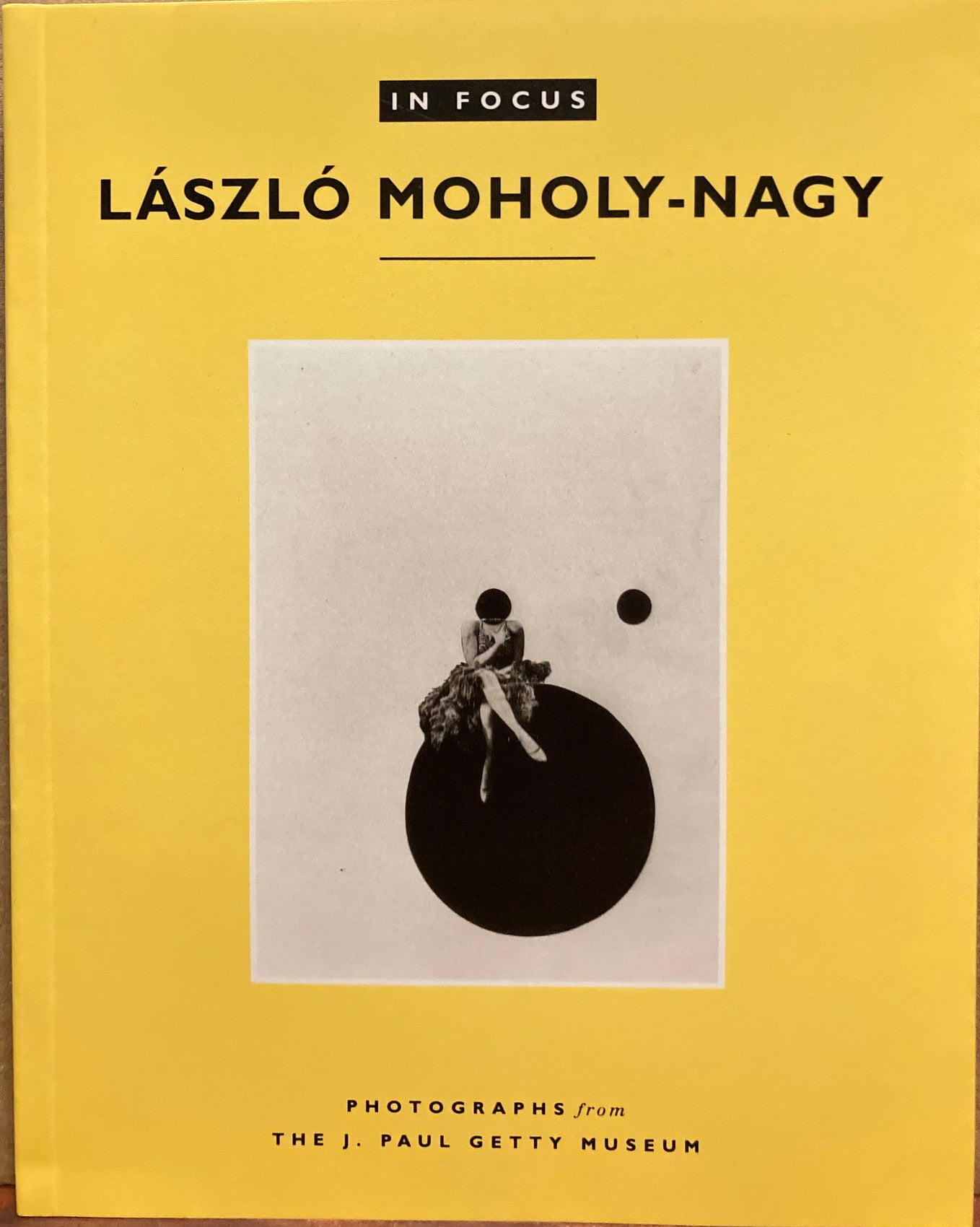
Moholy-Nagy, Laszlo. In Focus: Laszlo Moholy-Nagy.
Moholy-Nagy, Laszlo. In Focus: Laszlo Moholy-Nagy.
Impossible de charger la disponibilité du service de retrait
J. Paul Getty Museum, 1995. Photographs from the J. Paul Getty Museum. Written contributions by Thomas Barrow, Jeannine Fiedler, Charles Hagen, Hattula Moholy-Nagy, Weston Naef, Leland Rice, and Katherine Ware. Includes 45 plates, two text illustrations, chronology. One of the excellent series, In Focus, on famed photographers. Wraps, as issued, new condition.
Note: Born in Hungary on July 20, 1895, Laszlo Moholy-Nagy became a highly influential artist and teacher in the media of painting, drawing, photography, collage, sculpture, film, theater, and writing. He taught at the Bauhaus in Germany from 1923 to 1928 and after moving from London to Chicago in 1937, founded the New Bauhaus which continues today as the School of Design at the Illinois Institute of Technology. He brought a spirit of experimentation to his work; in photography, he is especially known for his photograms and bird's eye views. On November 24, 1946, Moholy-Nagy died in Chicago. Book summary:
In Focus: László Moholy-Nagy is a 128-page paperback monograph and critical commentary published by the J. Paul Getty Museum. Part of the museum’s highly regarded "In Focus" photography series, the volume serves as an essential introduction to the technical innovations and avant-garde philosophy of the Hungarian-born Bauhaus master.
Overview of the Book
-
The Content: The book highlights approximately 50 significant, high-quality duotone reproductions selected entirely from the Getty Museum's vast permanent collection of Moholy-Nagy’s photographic works.
-
The Commentaries: Each image plate is accompanied by individual, analytical text entries authored by photography curator Katherine Ware, who contextualizes the composition, historical backdrop, and technical execution of each piece.
-
The Structure: Beyond the curated visual plates, the volume concludes with an edited transcript of an intensive academic colloquium, offering a multi-faceted historical perspective on the artist’s lasting contribution to 20th-century art.
The Colloquium and Critical Analysis
The text and review sections are uniquely anchored by a diverse panel of writers, theorists, and practitioners whose transcribed debate forms the final portion of the book:
-
Charles Hagen: Authors and chairs the discussion, providing critical moderation and framing the historical lineage of Moholy-Nagy's theories on modernism.
-
Thomas Barrow: Authors commentary drawing from his perspective as a veteran photographer and art professor, analyzing the physical mechanics of the images.
-
Jeannine Fiedler: Authors insights based on her deep background as a Bauhaus Archive scholar, connecting the Getty images directly back to the school's German design roots.
-
Leland Rice: Authors analysis exploring the unique curatorial and collection history behind Moholy-Nagy's surviving vintage prints.
Core Photographic Themes
The text tracks Moholy-Nagy’s overarching pursuit of the "New Vision"—his absolute belief that the camera should expand human perception beyond the limits of natural sight.
-
Camera-less Experiments: Features exhaustive studies of his iconic photograms, demonstrating how he manipulated raw light, shadow, and chemical emulsion by placing physical objects directly onto photographic paper.
-
Photomontage: Highlights his complex, surrealist-leaning darkroom collages (which he called fotoplastiks), utilizing stop-action sequences, intersecting geometric ink lines, and repeating portrait variants.
-
Dynamic Perspectives: Showcases his use of radical vantage points, deploying dramatic bird's-eye views, extreme downward angles, and worm's-eye perspectives to challenge traditional notions of spatial horizon.
