Gary Saretzky Photo Books
Brown, Dean. Dean Brown Archive.
Brown, Dean. Dean Brown Archive.
Impossible de charger la disponibilité du service de retrait
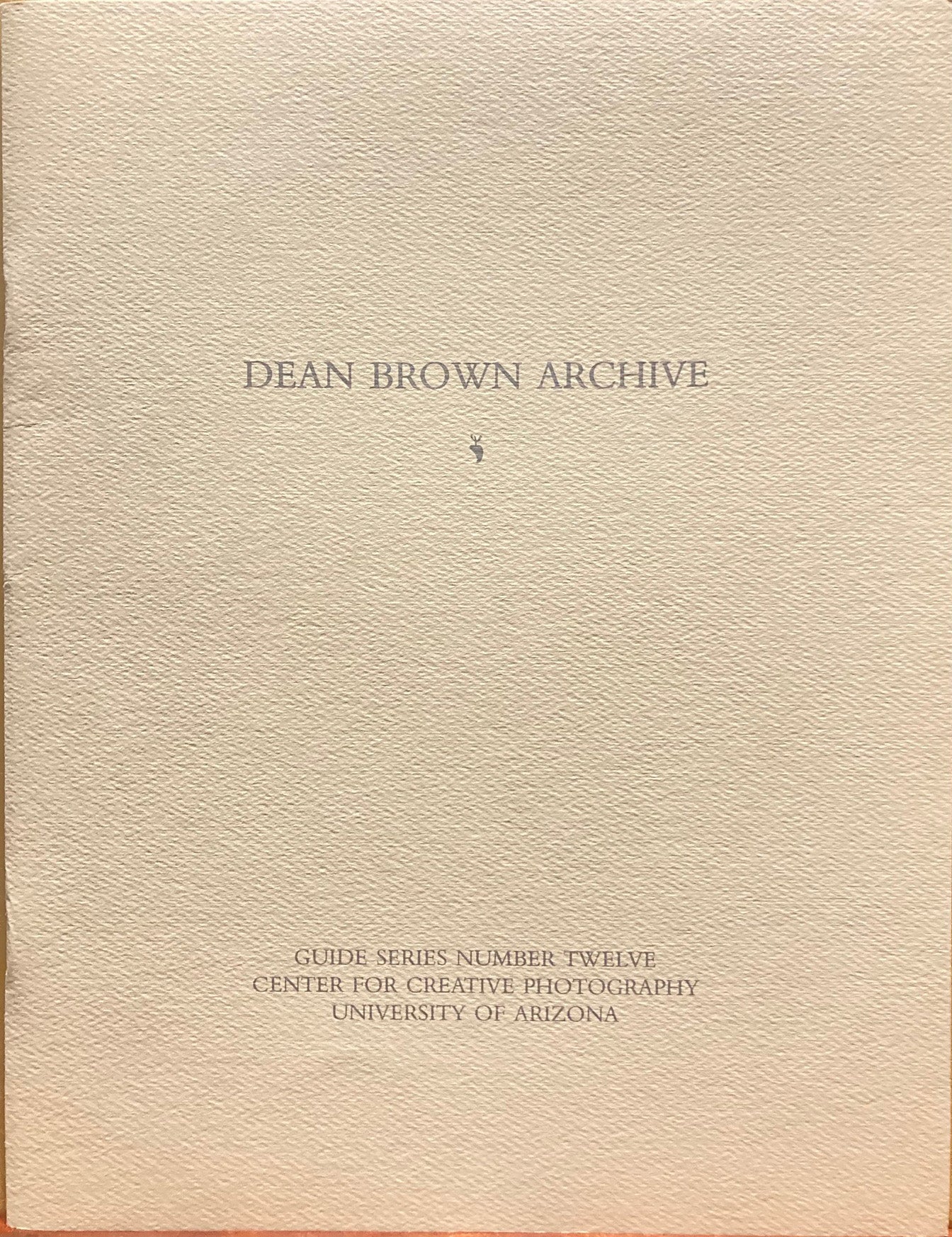
Arizona Board of Regents. Guide series Number Twelve, 1985. Center for Creative Photography University of Arizona. Compiled by Robert Sorgenfrei and David Peters. 36 pages. Illustrated with 14 color and 135 black-and-white reproductions from approximately 2,300 photographs in the collection. Describes series in the Brown archive, including Correspondence, Activity Files, and Photographic Materials. With biographical note, chronological list of exhibitions, and selected bibliography. Wraps, no fading on cover to which this publication is prone. Fine. Summary:
The Dean Brown Archive, housed at the Center for Creative Photography (CCP) at the University of Arizona, serves as the primary repository for the life's work and professional career documentation of American photographer Dean Brown (1936–1973).
Archive Contents & Scope
-
Photographic Holdings: Contains more than 50,000 35mm color transparencies, nearly 3,000 black-and-white prints, 150 color prints, contact sheets, negatives, and work prints.
-
Dye Transfer Technical Materials: Preserves extensive documentation detailing Brown’s self-taught mastery of the dye transfer printing process, including lab notes, separation negatives, matrices, and proof prints.
-
Professional Papers: Features business correspondence, shooting scripts, assignment logs, film records, expense accounts, project notes, date books, and a comprehensive collection of published tearsheets and periodicals.
-
Personal Correspondence: Includes personal records and photocopies of correspondence between Dean Brown and his wife, artist Carol Brown, who frequently accompanied him on field assignments.
Dean Brown (1936–1973) was an American photographer celebrated for his early color wilderness imagery and technical precision in dye transfer printing. Originally educated in linguistics and musicology—earning degrees from Brooklyn College and New York University—Brown left academia in 1967 to pursue photography full-time, initially focusing on portraiture, urban documentary, and architectural studies of opera houses. A pivotal 1969 trip to the American Southwest redirected his aesthetic focus toward nature, leading him to photograph remote wilderness areas across Alaska, the Sonoran Desert, and the Northeast using 35mm cameras with small apertures to preserve intricate clarity. To maintain visual intimacy, he favored small-scale prints and mastered the exacting color dye transfer process. Brown's career was tragically cut short in July 1973 when he suffered a fatal fall while on assignment for Time-Life Books in New Hampshire's White Mountains, dying three days shy of his 37th birthday and leaving behind a brief yet influential legacy in 20th-century American color landscape photography.
